The Ultimate Guide to Commercial Playgrounds for a Daycare or Childcare in New Jersey
A New Jersey daycare playground is your responsibility as the director, and how much outdoor space you have to provide depends on your program. A standard center needs at least 350 square feet of outdoor play space, but a Head Start site needs 75 square feet per child and a state-funded preschool needs 100, so clearing the basic daycare rules doesn’t mean you’ve met the standard that actually applies to you. This guide is written for the person who owns that call: whether you need a new playground or just an inspection and a few fixes, how much space and money it takes, what’s right for the ages you serve, and where my job as your dealer ends and yours as the owner begins.
You already know your center has to be licensed. What catches a lot of directors off guard is that the playground in your yard is your responsibility. The code an inspector holds it to lives in the state building code, not the childcare manual you read to get licensed. If something out there is wrong, it’s your name on it, not your dealer’s.
Two kinds of daycares call me. Some are planning a new playground and want to get it right. A lot of them already have one that hasn’t been touched in years, an inspection is coming, and they need someone to walk it and fix what’s off. This guide is for both, and it’s written for the person who owns the decision.
I’ve run NJ Swingsets & Playgrounds out of Midland Park since 2013, and I work with daycares a lot, some seasons very frequently, and across the state, from Bergen County down to the shore and out to Camden. My job is to know the rules cold and make sure what goes in your yard is right. Yours is to own the call. Here’s what you actually need to decide.
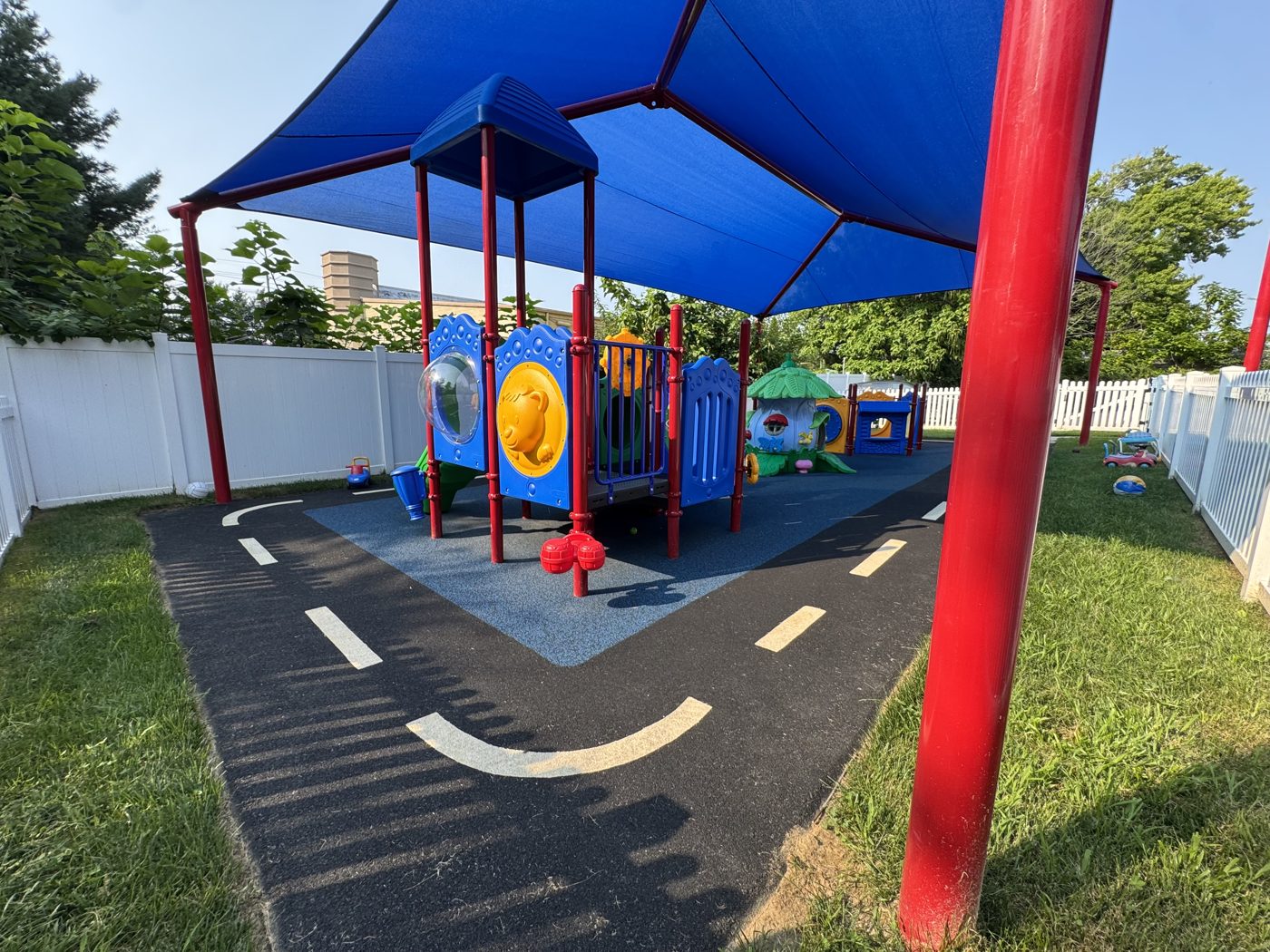
Creative Nursery, North Brunswick. Poured-in-place rubber with a road-play design under shade sails, the two things daycares ask for most.
Do you need a new playground, or just an inspection and a few fixes?
Not every daycare needs a new playground. If yours has been sitting for years and an inspection is on the calendar, you may just need someone to go through it, tell you plainly what has to be fixed, and handle it, not sell you a rebuild.
A big share of my daycare calls aren’t new builds at all. They’re a playground that hasn’t been maintained in a long time, an inspector is coming, and the director wants a straight answer on what needs to happen. Sometimes it’s small, a loose bolt, a worn swing hanger, a surface that’s gone thin under the slide. Sometimes it’s a real safety problem that’s been there for years. Either way, it’s a lot cheaper to find it before the inspector does.
I’m a Certified Playground Safety Inspector, so this is exactly the call I like getting. I’ll walk your existing playground, give you the real list, sorted by what’s urgent and what can wait, and I can do the fixes myself. No pressure to replace anything that has good years left in it.
Have a playground and an inspection coming? Let me look at it before someone else does. I’ll tell you what actually needs fixing, and what doesn’t.
A center licensed or relocated on or after September 1, 2013 needs at least 350 net square feet of outdoor play space, plus 35 more for each child over ten using it at one time. It has to be net usable space, not your whole lot. Older centers fall under an earlier, smaller rule.
That number is yours to provide, so nail it down before you spend anything. A few things directors miss:
What the space rule actually means for you
Net usable, not gross. Fencing setbacks, drainage swales, and anything hazardous get carved out before you count. A 400-square-foot yard on paper can come up short once you subtract the parts kids can’t safely use.
There’s a waiver. A center can be excused from the outdoor requirement entirely if it provides an adequate indoor gross-motor room. Real option, though most families want the real thing outside.
Fencing kicks in near hazards. If the play area sits near a street, a driveway, a parking lot, water, or a steep grade, you need a barrier. The code names the trigger and leaves the height to the building code, which is my job to get right.
Most daycares bring in an engineer or architect for design and layout. If yours is a simpler setup, I can do a site visit and tell you whether we can work out a design for your space or not.
Are you held to a higher bar than basic licensing?
Maybe, and it’s the most expensive thing to get wrong. If you run a Head Start room or a state-funded (former Abbott) preschool, your outdoor space requirement is higher than plain daycare licensing. Passing licensing does NOT mean you pass those.
Your real requirement is whatever the strictest standard on your site says, and three different numbers can govern the same yard:
If your site is…
Governing rule
Outdoor space per child
A licensed daycare (post-2013)
N.J.A.C. 3A:52
350 sq ft base, ~35 per additional child
A Head Start / Early Head Start program
45 CFR 1302.21
75 sq ft per child
A state-funded (former Abbott) preschool
N.J.A.C. 6A:26
100 sq ft per child using it at once
Read that twice if you’re a Head Start site or a district-contracted pre-K. A yard that clears daycare licensing can still fall well short of the 75 or 100 square feet per child those programs demand, and finding that out after you’ve built is a costly redo. Knowing which bar applies to you is the first thing I check on a site visit.
If you’re in Grow NJ Kids, your outdoor environment gets scored through the ECERS-3 and ITERS-3 rating scales. There’s no square-foot mandate in the rating itself, but a bare code-minimum yard tends to score low, and your rating can affect the funding and the families tied to it. A better yard scores better, and that rating follows you.
What does it cost, and how do daycares pay for it?
What should I budget?
A typical daycare or childcare playground runs about $30,000 to $75,000 for a small daycare and $75,000 to $200,000 for a larger one. Both ranges cover equipment, surfacing, site work, and installation. Where you land depends on your enrollment, your age mix, and your site. I’d rather give you a real figure after I’ve seen your space than a number that’s off by double.
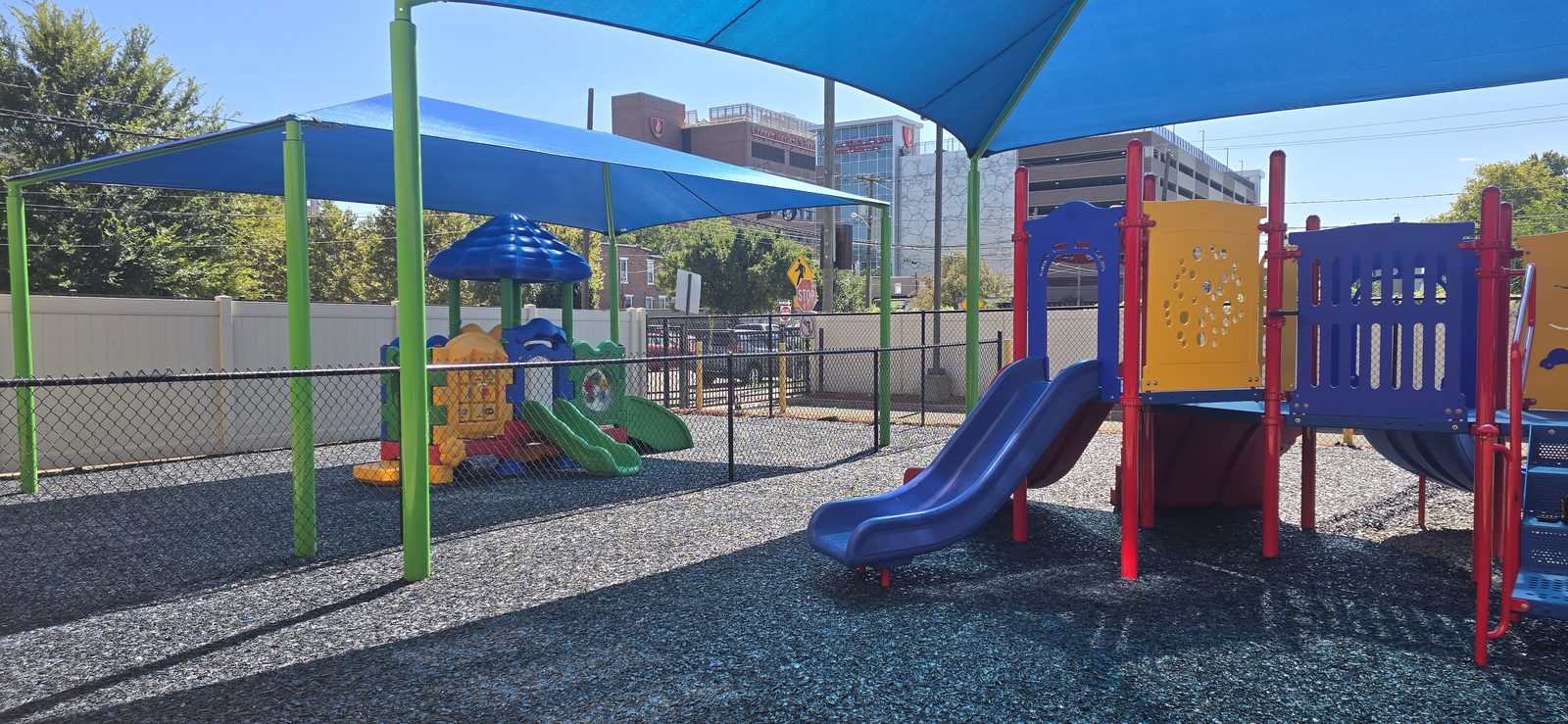
El Centro daycare, Camden: equipment, shade and bonded rubber surfacing
On paying for it, let me save you a wrong turn. New Jersey’s marquee playground grants, Green Acres and the county open-space funds, are written for public land and municipal applicants. A private daycare usually can’t tap them, so don’t build a plan around a grant that isn’t for you. Head Start and state-funded programs have their own capital pathways through their sponsoring agencies, and plenty of centers fund a playground the same way they fund a roof, out of the operating or capital budget, or a parent-and-community campaign.
Choosing the right playground for your ages, and who’s responsible
Here’s where the ownership line matters most. The equipment has to fit the ages you serve, and the safety surface under it has to be right for the heights kids can fall from. Both are ultimately your responsibility as the owner. My job is to recommend the proper equipment and specs and make sure what you buy is compliant, but it goes in under your name, so you should understand what “right” looks like. We install these for nurseries and preschools around the state, and that ownership line is the same on every one.
On equipment, the rule of thumb is simple: buy for the ages actually in your yard. A structure built for five-to-twelve-year-olds, tall climbers, overhead rings, a fast slide, is wrong for a room full of two-year-olds, and an inspector will flag it. If you serve a wide range, from infants through pre-K, you lay out separate zones by age and keep them divided, rather than buying one big structure and hoping. That separation is how you keep a toddler off gear sized for a five-year-old, and it’s what an inspector expects to see.
On surfacing, you’re not the one calculating fall zones, but you own the outcome, so here’s the short version. The surface under the equipment is safety gear, deep enough for the height a child could fall from, kept clear around each piece. Getting that right is on me. What I’d flag for you as the owner: for a toddler yard specifically, I recommend a poured or bonded rubber surface over loose fill like mulch. Not because a rule forces it, but because little kids put everything in their mouths and loose material is a real choking and ingestion risk at that age. It’s also easier to keep clean and gives a wheelchair or a walker a smooth path. That’s my recommendation, not a rule.
It’s also what daycares ask us for. Poured-in-place rubber and a shade structure over the play area are the two requests that come up on nearly every daycare job we do. The rubber is safe and easy to keep clean, and the shade keeps kids and hot equipment usable through the afternoon.
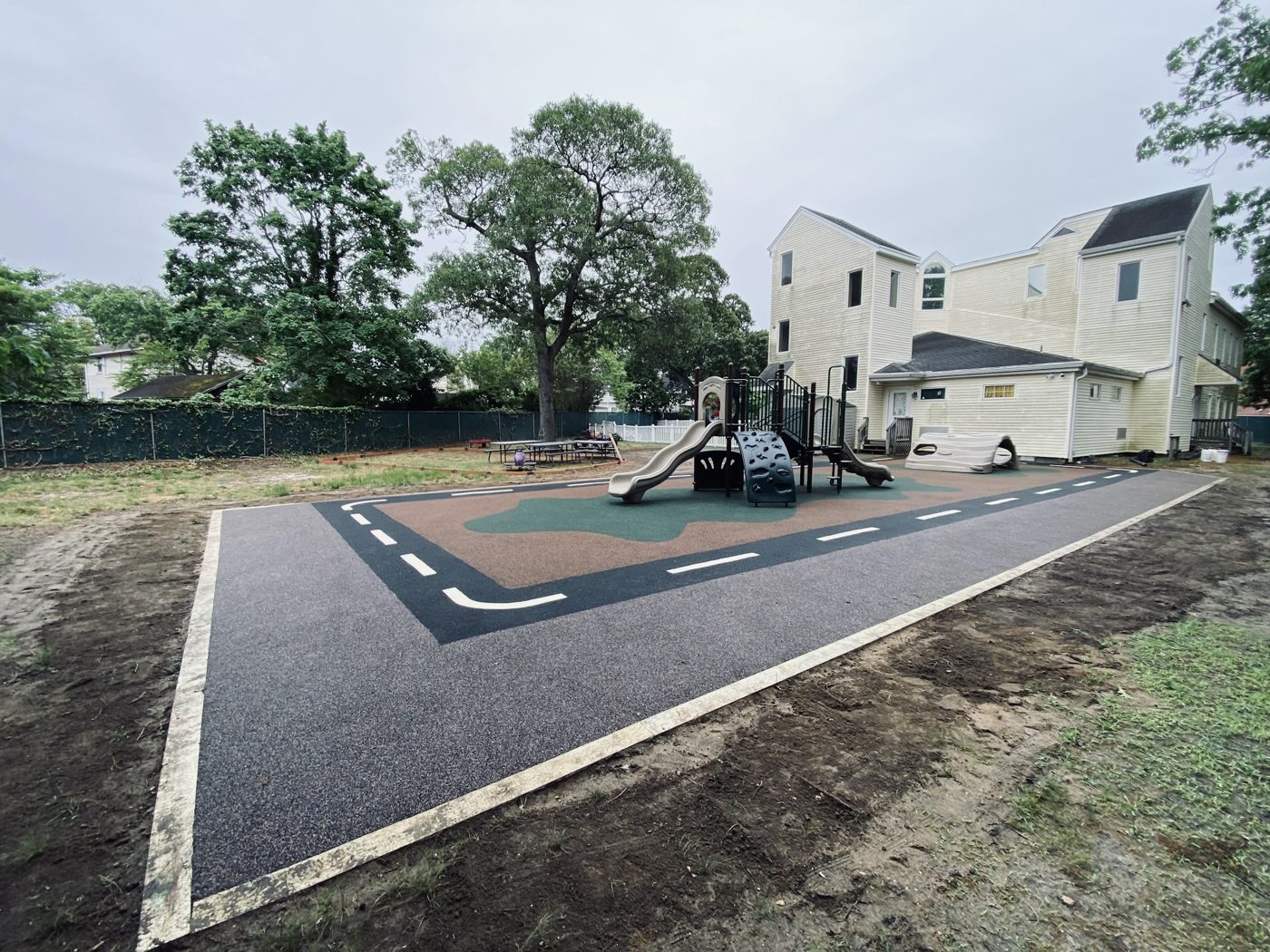
Son Catchers Daycare, Somers Point. Poured-in-place rubber with a road-play design.
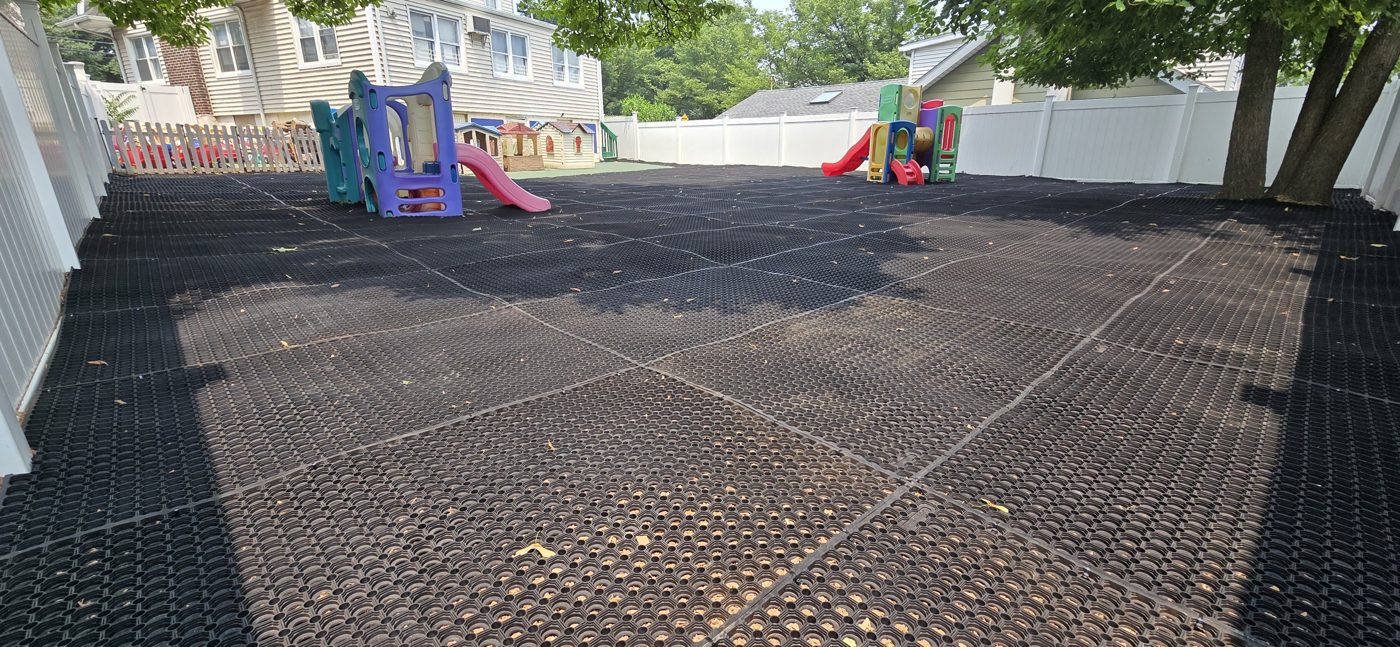
Poured-in-place isn’t your only option. Rubber mats or tiles do a similar job, firm underfoot and ADA-accessible, and mats can go down over the mulch you already have instead of tearing it out.
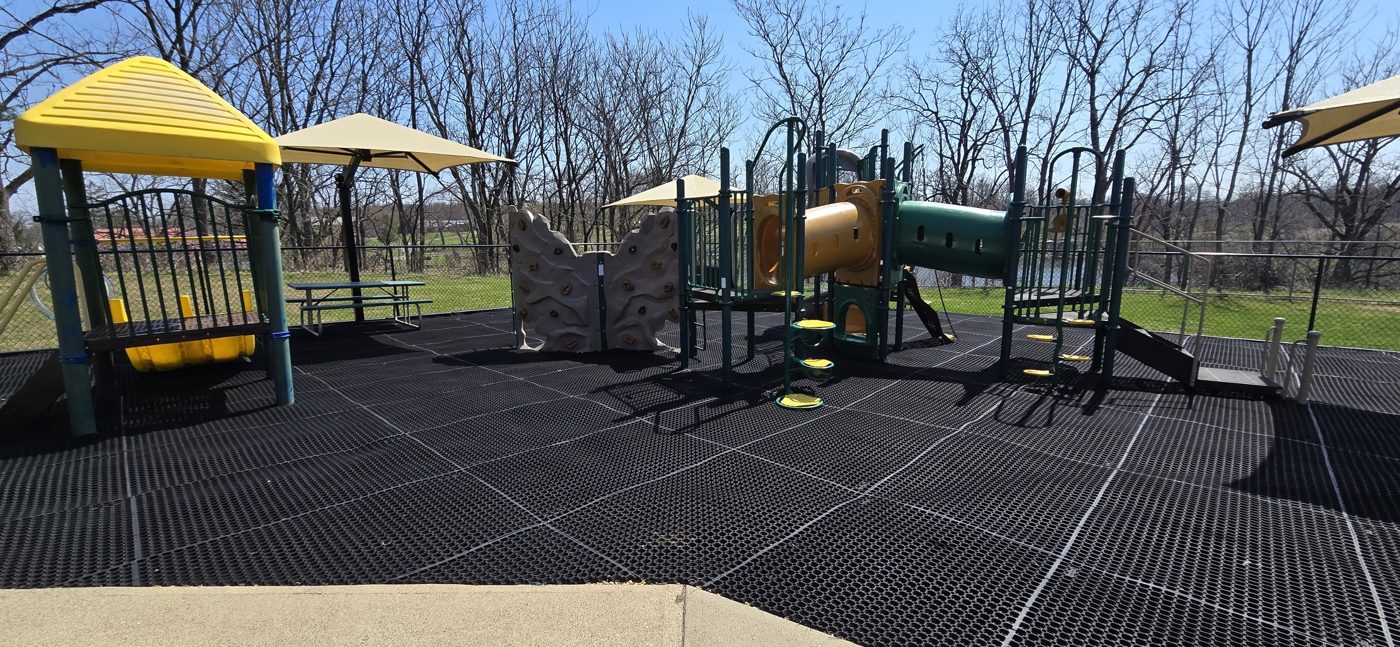
Adventureland Daycare, Paramus. Rubber mats laid over the existing mulch, a firm ADA-accessible surface without tearing out the loose fill underneath.
Not sure which equipment fits your ages, or which bar you’re held to? Tell me your enrollment mix and your program, and I’ll tell you what works before you’re staring at a quote.
There’s no fixed timeline. What actually drives the calendar is how fast you make decisions, how quickly the equipment gets chosen, and the time of year, because in the Northeast you can’t set footings or pour a surface into frozen ground.
The physical install is the fast part. The calendar stretches or shrinks based on the three things above, and the biggest one is usually the decisions on your end, picking the layout, signing off on the equipment, settling the budget. I keep it moving, but a project waiting on a committee moves at the committee’s pace. If you’re aiming for a spring or summer opening in New Jersey, start the conversation over the winter.
Shade isn’t a licensing requirement. For a daycare it’s still one of the smarter add-ons. Your kids are outside more than almost any other group, often twice a day all summer, and their skin burns fast. Dark rubber surfacing and metal slides get hot enough to shut down the yard by early afternoon. A shade structure over the main play zone protects skin and keeps the surface usable through the hottest part of the day. Plan it in when you build, it costs far less than adding one after the fact.
Second Home Childcare Center, Wantage. Shade umbrellas over the play zone.
Planning, replacing, or just trying to pass an inspection?
Tell me your ages, your space, and your program, or point me at the playground you already have. I’ll come out, look at it, and tell you what your situation actually requires, before you’re committed to anything.
Free site visits across NJ. Ask for Jay, that’s me.
FAQ: Daycare and childcare playgrounds in NJ
How much outdoor space does a NJ daycare playground need?
For centers licensed on or after September 1, 2013, at least 350 net square feet of outdoor play space plus 35 more for each child over ten using it at once. It has to be net usable space, not your whole lot. And if you’re a Head Start or state-funded preschool site, your bar is higher, 75 or 100 square feet per child.
Do I need a new playground, or can I just get my existing one inspected?
Often just inspected. A lot of daycare calls are an older playground that hasn’t been maintained with an inspection coming, and the fix is a safety inspection plus a few repairs, not a rebuild. I’m a Certified Playground Safety Inspector, so I can walk it, give you a clear list, and handle what needs doing.
Am I held to a higher standard if I’m a Head Start or state-funded preschool?
Yes. Head Start requires 75 square feet of outdoor space per child and a state-funded (former Abbott) preschool requires 100, both higher than plain daycare licensing. Passing licensing doesn’t mean you meet those, so it’s the first thing to check before you build.
How much does a daycare playground cost in NJ?
A typical daycare playground runs about $30,000 to $75,000 for a small daycare and $75,000 to $200,000 for a larger one. Both ranges cover equipment, surfacing, site work, and installation. The real number depends on your space and enrollment, which is why I quote after a site visit.
Can a private daycare get a grant for a playground in New Jersey?
Usually not from the big state programs. Green Acres and county open-space funds are written for municipalities and public land, not private centers. Most private daycares fund a playground through their own budget or a capital campaign. Head Start and state-funded programs have their own capital pathways.
Who’s responsible for making sure the playground is safe and compliant?
You are, as the owner. It’s your playground and your name on the inspection. My job as your dealer is to recommend the proper equipment and specs and make sure what you buy is compliant, but the responsibility for what goes in the yard is yours, which is exactly why you want a dealer who knows the code cold.
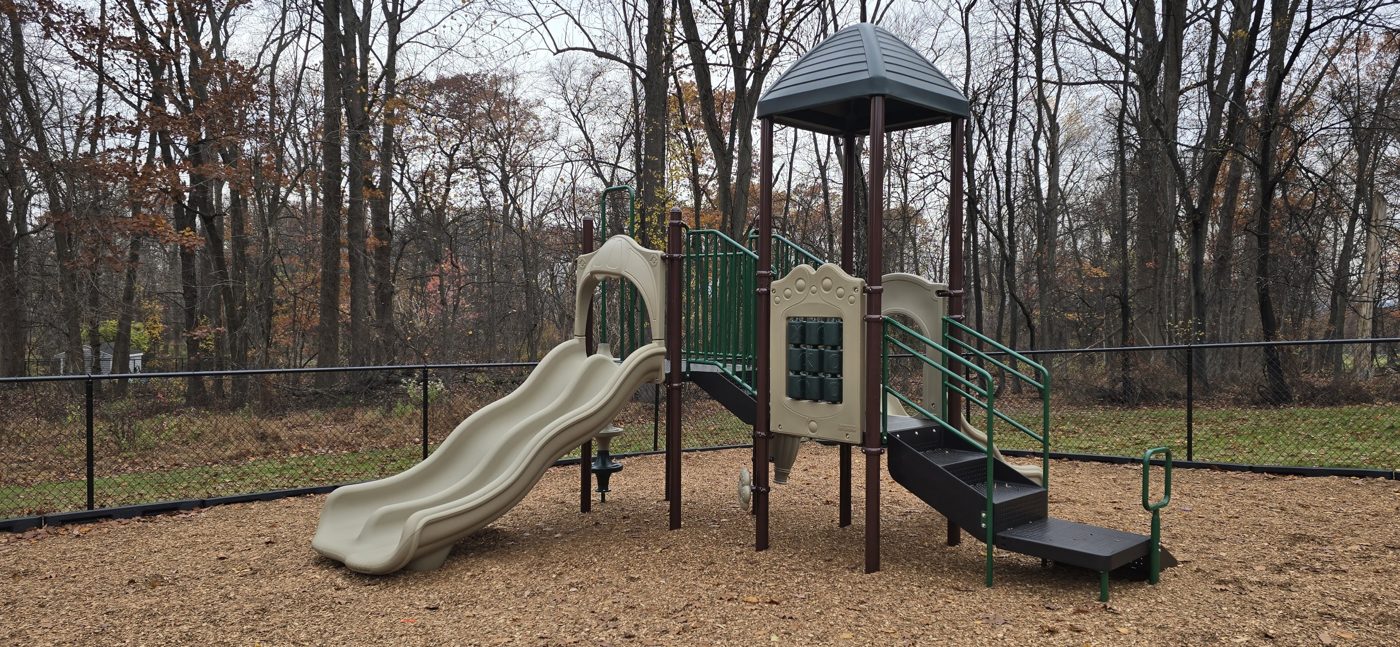
Little Brook Montessori, West Caldwell.
About Jay Samolowicz
Owner, NJ Swingsets & Playgrounds
CPSI #59746-1226 • RISC Certified • NPCAI Member • ACR Member
I started NJ Swingsets & Playgrounds in 2013 out of Midland Park, NJ. The commercial side is most of what I do now, and daycares are a big part of it, private centers, church preschools, Head Start rooms, and state-funded pre-K. I manage every job myself, from the first site visit to the CPSI inspection. My own kids play on the equipment we sell.
NJ Swingsets Blog, more guides on playground buying, safety, surfacing, and grants in New Jersey.
2026 NJ Playground Grants Guide for Parks & Municipalities
New Jersey has real money for municipal playgrounds, but how much you get depends on who you are and what you build. A standard municipality’s Green Acres Park Development grant covers 25% of the project. Make the playground completely inclusive and that climbs to 50%. LRIG adds up to $75,000 with no match required, and CDBG can help in lower-income areas. The big deadlines land in late February, not spring, and most grant-funded projects run 12 to 24 months from application to ribbon-cutting.
If your town is looking at replacing or building a playground, there’s real grant money for it in New Jersey. The main sources are Green Acres, LRIG, CDBG, county open space trust funds, and federal earmarks, and each has its own rules about who qualifies, how much you get, and what it covers. LRIG alone hands out grants up to $75,000, and it’s now in its sixth year.
The money is real, and a good share of my municipal clients end up with some grant funding, depending on which programs fit their project and their situation. The hard part isn’t that the money doesn’t exist. It’s knowing which programs your town actually qualifies for, how they fit together, and how to build an application that actually gets funded.
That’s what this guide walks through. The programs are real and the numbers come straight from the state’s own application documents. Where the answer depends on your town’s situation, I’ll say so instead of handing you a figure that might be wrong.
The NJ Municipal Playground Funding Landscape in 2026
NJ towns have five main ways to fund a playground: Green Acres Park Development, LRIG, CDBG, county open space trust funds, and federal congressional earmarks. Green Acres is one program, not three: the inclusive-playground “Jake’s Law” premium and the Urban Aid tier both live inside it. Most funded projects pull from two or three at once.
The backbone is Green Acres. Run by the NJ Department of Environmental Protection, it’s funded park development for decades. Jake’s Law added a push specifically for inclusive design. It’s named for Jacob “Jake” Cummings-Nasto, a Cherry Hill toddler. His family built Jake’s Place, South Jersey’s first fully inclusive playground, in his memory. And LRIG, now in its sixth year, was built for the smaller neighborhood upgrade that was never going to compete for a half-million-dollar Green Acres award.
On top of the state programs, most NJ counties have voter-approved Open Space Trust Funds. These are dedicated property tax levies, so the money can only go to park development and acquisition. Programs vary a lot by county, and not every county’s levy is active in a given year, so confirm yours before you count on it.
Key NJ Municipal Grant Programs at a Glance
Green Acres Park Development, base grant: standard municipality 25%, county 50%, Urban Aid municipality 75%, nonprofit 50% (you cover the rest)
The completely-inclusive-playground premium: adds 25 points, so municipality 50%, county 75%, Urban Aid municipality 100%, nonprofit gets no premium
Green Acres award caps: roughly $600,000 for a standard municipality up to about $2.1 million for the most densely populated counties, depending on applicant type
LRIG: up to $75,000, no required match, run by NJ DCA (not DEP)
CDBG: lower-income areas only, roughly a $400,000 cap, match based on your town’s state ranking
County Open Space Funds: varies by county, so call your county parks office
Most grant applications don’t get funded. The figure that gets thrown around nationally is roughly one in ten. That sounds brutal until you look at why applications fail. The bulk come from organizations applying to programs they don’t qualify for, or submitting thin documentation, or writing a generic narrative that never shows real community need. A solid application from a town that genuinely qualifies does a lot better than one in ten.
Jake’s Law Grants in New Jersey: What They Actually Are Now
The Jake’s Law pilot grant is gone. Inclusive playgrounds now get funded as a premium inside Green Acres Park Development: 25 extra percentage points on your grant. For a municipality that means a 50% grant with a 50% match, not the 75% you may have read about. A county gets 75%, and an Urban Aid municipality gets a full 100%.
If you searched for “Jake’s Law grant” and landed here, let me save you some confusion. There is no longer a standalone Jake’s Law grant handing out $500,000 to $750,000. The pilot program ended, and the state says so in plain language in its 2026 Park Development application.
What replaced it is actually simpler. Build a completely inclusive playground, one that clears the state’s full checklist rather than just ADA minimums, and Green Acres adds 25 percentage points to whatever your base grant would have been. A standard municipality’s base Park Development grant is 25%, and the inclusive premium takes that to 50%. Counties do better, going from 50% to 75%. And an Urban Aid municipality? From 75% to a full 100%.
So the real municipal math looks like this. A $200,000 inclusive playground gets you $100,000 from the state and $100,000 you cover locally. Fifty-fifty. That “pay back only 25 percent” number floating around only holds if you’re a county, not a municipality. Worth being clear about that before you build a budget on it.
The good news is the premium usually more than pays for itself. Going from ADA-minimum equipment to genuinely inclusive costs maybe $10,000 to $30,000 more. That buys accessible swings with transfer supports, sensory panels, and poured surfacing a kid in a wheelchair can actually roll across. The grant premium is often several times that.
What “completely inclusive” actually requires: To earn the premium, your playground has to clear the state’s Completely Inclusive Playground checklist, drawn from the DCA subcodes. That means fencing so a child can’t wander off on their own, at least 20% of the surfaced and equipment area shaded, quiet spaces for kids with sensory needs, a family or assisted-use restroom if the park has restrooms serving the playground, and equipment that goes past ADA minimums (at least half your elevated play components and a quarter of the ground-level ones accessible). Jake’s Law is P.L. 2018 c.104, N.J.S.A. 52:27D-123.10, if your grant writer wants the citation.
Two rules that can quietly cost you the premium, or the whole grant:
Don’t bundle. The premium only applies if the project scope stays limited to the inclusive playground and the improvements the state requires around it. Roll the playground into a bigger park renovation with new trails, a pavilion, a parking lot, and the ENTIRE application drops back to your base grant rate. For a municipality that’s the difference between 50% and 25%.
Watch the 20-year clock. If a playground was built with Green Acres money less than 20 years ago, you generally can’t get Green Acres money to redo it, not without a Facility Refunding Waiver, and that only covers normal wear and tear, not neglect or vandalism. Check the funding history of the site before you plan a replacement.
And one more: if your project can’t get built without a second, future round of Green Acres funding, the state calls it ineligible. They fund projects that can actually finish.
The deadline sits in late February, and it doesn’t slide: The 2026 Green Acres round closed February 27. Miss it and you wait a full year. The next round should open for a similar late-February 2027 date, but verify the exact date with Green Acres, since they post it each cycle. I’d start four to six months out, which gives you time for public input and a real spec quote.
NJ Green Acres Local Parks (Park Development)
Green Acres Park Development is the base program under all of this. A standard municipality’s base grant is 25% of the project, so you cover the other 75%. It’s the inclusive-playground premium that lifts a town to 50%. Awards run from about $600,000 for a standard municipality up to roughly $2.1 million for the largest counties, and the program funds broad park work: playgrounds, surfacing, shade, fencing, trails, pavilions, parking.
This is the workhorse of NJ park funding, and it’s worth being clear about the base numbers, because they’re less generous than a lot of people assume. A standard municipality’s Park Development grant covers 25% of the project. Not half. The county rate is 50%, Urban Aid municipalities get 75%, and nonprofits 50%. Your match is whatever’s left.
A couple of things work in your favor. Green Acres funding isn’t subject to local government CAP laws, which matters if your town is bumping against its caps elsewhere. And Green Acres offers a 0% interest loan, up to 20 years, to cover the match portion. That’s subject to available funding, so it isn’t guaranteed, but it’s there.
Where towns get tripped up is the match. Not every source counts. You can’t use other Green Acres funding as your match, and you can’t use other Garden State Preservation Trust money like Farmland Preservation or the Historic Trust either. Donated goods and services that don’t run through the public bidding process don’t count. So “we’ll cover the match with another grant” is true for some sources and flatly false for others. Check each one before you promise the state where your match is coming from.
Green Acres Urban Aid Municipalities
If your town is a designated Urban Aid municipality, you’re in a better spot than most. Your base Park Development grant is 75%, and with the inclusive-playground premium it goes to a full 100%. That’s one of the biggest funding advantages in the program. Confirm your Urban Aid status with the NJ Department of Community Affairs before you build a budget on it.
Working on a Green Acres application? I put together quotes formatted for exactly what these applications need: equipment specs, ADA and inclusive documentation, surfacing, installation broken out line by line. Call me at 201-670-4000 or ask for a quote online.
LRIG: The Best Option for Smaller Projects
LRIG hands out up to $75,000 for playground equipment, surfacing, accessible routes, and shade, with no required match. The 2026 deadline was February 13, and the program has about $10 million to give out each year. One catch worth knowing: it’s run by NJ DCA, not DEP. People mix that up constantly.
LRIG is the program towns overlook, because they assume they have to chase Green Acres. But if your project is in the $50,000 to $100,000 range, like one structure replacement, new safety surfacing, or an accessible pathway, LRIG is often the better first call.
It lists playground equipment as an eligible expense in black and white. The $75,000 cap is a recommended maximum, and DCA can go above it at their discretion, but plan around the $75,000. The best part is there’s no required match. Putting up local money only helps your score, it isn’t a gate. And LRIG stacks. A town that lands $75,000 from LRIG and $50,000 from county open space is at $125,000, which is real money toward a quality install with surfacing.
LRIG at a Glance
Who can apply: NJ counties, municipalities, school districts
Award: up to $75,000 (a recommended max, though DCA can exceed it)
Match: none required, though a local match earns priority points
Annual pool: about $10 million (FY2026, now in its sixth year)
2026 deadline: February 13
Who runs it: NJ DCA, Division of Local Government Services (NOT DEP)
If you’re going after LRIG and a Green Acres program in the same year, just make sure the two applications don’t cover the same work. You can’t get two grants to pay for the same swing set.
CDBG: What “Zero Match” Really Means for LMI Communities
CDBG can fund a playground, but only in a lower-income area, where at least 51% of the people your park serves fall in the low-to-moderate income range. For most NJ towns it runs through the state’s Small Cities program at NJ DCA, with a cap around $400,000 and a required match based on your town’s state ranking. The old “zero match, easy money” reputation isn’t accurate here.
CDBG is federal HUD money, and how you get it depends on where you are. The big HUD “entitlement” counties (Bergen, Monmouth, Middlesex) run their own CDBG locally. Everywhere else, it comes through the state-administered Small Cities program at NJ DCA. So the right first phone call usually isn’t your county planning office, it’s the state. That’s a common wrong turn.
The real gate is income. A playground has to serve an area where at least 51% of residents are low-to-moderate income. If your park sits in an LMI neighborhood, you’re likely in the zone. If it doesn’t, CDBG generally isn’t your program. And it isn’t free money the way it sometimes gets described. The state’s Small Cities Public Facilities awards cap around $400,000, your match is set by your town’s Municipal Revitalization Index rank, and Davis-Bacon prevailing wages apply to any construction contract over $2,000, which pushes your labor cost up. Factor that into the quote you collect.
CDBG timelines run longer than the state programs, because federal compliance adds steps. Plan on 18 to 24 months. Where a town qualifies, it can meaningfully cut the local share. Just don’t build a budget on the “covers everything” version of CDBG. It doesn’t.
How to Stack Multiple Grants for One Project
Most NJ programs let you combine sources, and towns routinely fund one playground from two or three. Two rules run the whole thing: you can’t bill the same expense to two programs, and not every source is an eligible match for Green Acres. Get the second one wrong and you can lose an award you thought you’d secured.
Here’s how a stack can come together. A township wants to replace a playground and add safety surfacing, call it $150,000 all in. They win a $75,000 LRIG grant for the equipment. Their county open space fund kicks in $50,000 for the surfacing and pathway. The township covers the last $25,000 from capital reserves. Three sources, one project, no expense billed twice, because the equipment, the surfacing, and the township’s share each sit on their own line.
What you can’t do is pay for the same swing set out of two grants. If LRIG buys the equipment, Green Acres can’t also buy the equipment. But Green Acres could fund the accessible surfacing and pathway while LRIG covers the structure. Keep each program on its own scope. And remember the match rule from earlier: some sources can serve as a Green Acres match and some can’t, so confirm before you commit.
Grant Program
Award Range
Your Match
Deadline
Best For
Green Acres Park Development (base)
~$600K–$2.1M by applicant type
Muni 75% / county 50% / Urban Aid 25%
Late Feb
Broad park improvements
…with inclusive (CIP) premium
Same caps
Muni 50% / county 25% / Urban Aid 0%
Late Feb
Completely inclusive playgrounds
LRIG
Up to $75K
None required
Feb 13 (2026)
Neighborhood park upgrades
CDBG (Small Cities)
~$400K cap (Public Facilities)
Based on MRI rank
Varies
Projects in LMI areas
County Open Space
Varies by county
Varies
Varies
Match or gap funding
County Open Space Trust Funds: How to Find Yours
Most NJ counties run an Open Space Trust Fund off a voter-approved property tax levy, money that can only go to park acquisition and development. The programs vary a lot in award amounts, match requirements, and application cycles.
Some counties fund municipal projects directly. Others fund only county-owned park improvements, with municipalities competing through a county process. Award amounts, match rules, and application cycles vary a lot from one county to the next.
The starting point is simple: call your county’s parks or open space office and ask specifically about municipal playground eligibility. A lot of towns miss this money because they never asked.
When to Hire a Grant Consultant
For a project over $200,000, a grant consultant often pays for itself. Two NJ firms I point municipalities to are Triad Associates and Bruno Associates, both grant specialists. A smaller LRIG application you can usually handle in-house with help from the agency.
I get this question a lot: do we need a consultant, or can we write it ourselves?
For a $75,000 LRIG application, you can probably do it yourself. The agency staff are genuinely helpful and the application is straightforward. For a $500,000-plus Green Acres application, I’d think hard about bringing in a professional.
Two firms I refer people to:
Triad Associates (Vineland, NJ), triadincorporated.com. Founded in 1978, they’ve secured over $1.7 billion in grants and work with the NJ State League of Municipalities as a grants consultant. Strong on Green Acres, CDBG, and community development.
Bruno Associates (Clifton, NJ), brunoassociatesinc.com. A family-run NJ grant firm that’s been at it for decades, with more than $1 billion secured for municipalities, counties, school districts, and nonprofits, Green Acres included.
What a good consultant really brings isn’t writing ability. It’s knowing which programs you’ll actually qualify for, how to frame the project, and how to build the community-need documentation that separates funded applications from the rest.
How NJ Swingsets & Playgrounds Helps with Grant-Funded Projects
I put together grant-ready quotes built for the program you’re applying to: equipment specs, ADA and inclusive-checklist documentation, surfacing specs, and installation costs broken out line by line. I also help you pick equipment that clears the inclusive-playground checklist, which is what earns the Green Acres premium.
Here’s what I do on a grant-funded project that’s different from a regular quote.
Grant applications need more than a price. They need detailed equipment specs, ADA and inclusive-design documentation, surfacing specs with materials, installation costs broken out on their own, and often manufacturer certifications. I prepare all of it. A line that just reads “playground equipment, $80,000” gets an application questioned or rejected. A few pages of real specs, with IPEMA certification and line-item costs, doesn’t.
For inclusive projects, I help towns choose equipment that clears the state’s CIP checklist, not just ADA minimums. That checklist is what unlocks the 25-point premium, and it’s the highest-payoff decision on the whole project.
Start before the design is locked: Grant applications often want a preliminary design or scope. I’d rather work with you before the design is final, so the equipment fits both the grant’s scoring and what you actually want the park to be. Starting after the design is locked sometimes means redrawing it to qualify, which costs time you may not have against a deadline.
I can also help with the equipment side of the “compelling need” section, which is where a lot of applications fall apart. The grant writer builds the narrative, but the pieces that back it up are mine to hand you: the safety-inspection findings, the accessibility gap, the spec-level detail. The strongest applications I’ve supplied tie the playground to something documented, like aging equipment that’s become a safety problem, no accessible play within miles for kids with disabilities, or a real gap in park access relative to state averages.
Grant Project Timeline: What 12 to 24 Months Actually Looks Like
Most grant-funded NJ playground projects take 12 to 24 months from application to opening day. A lot of that is waiting: award decisions take 3 to 6 months, design and bidding add another 3 to 7, and equipment lead time from the manufacturer runs 8 to 16 weeks on top of all that.
The number that surprises people is equipment lead time. Commercial playground equipment from the big national manufacturers usually takes 8 to 16 weeks from order to delivery. And that’s after the grant is awarded, after the design is approved, after the bid process runs, after the contract is signed. If you want the playground open for summer 2027, your application probably needs to be in this coming late February.
Phase
Duration
Key Activities
Planning & Community Input
2–4 months
Needs assessment, public meetings, design concepts, equipment selection
Grant Application Prep
1–2 months
Application writing, quotes, documentation, community need letters
Award Decision
3–6 months
State review period, nothing to do but wait
Design & Engineering
2–4 months
Final plans, bid documents, engineering review if required
Procurement / Bid Process
1–3 months
Bidding, vendor selection, contract execution
Equipment Manufacturing & Shipping
8–16 weeks
Lead time from manufacturer, plan around seasonal installation windows
Site Prep & Installation
4–8 weeks
Site work, equipment installation, surfacing, inspection
TOTAL
12–24 months
From application submission to ribbon-cutting
One more timeline note: put a maintenance plan in your budget. Some reviewers dock applications that don’t address long-term upkeep. Showing you’ve planned for NJ’s annual playground inspections, which the state’s playground subcode ties to ASTM F1487 standards, signals you’ll be a responsible steward of the grant. It’s an easy place for an otherwise strong application to lose points.
Common Grant Mistakes That Kill Applications
Six of the most common reasons NJ playground grant applications fail: missing the deadline, underestimating your match, generic community-need narratives, ignoring accessibility, vague budget line items, and forgetting soft costs like engineering and contingency.
I’ve been on the vendor side of enough of these, and heard back from enough municipalities after a decision, to see the patterns in what goes wrong. These six account for most of the failures I’ve seen.
Missing the deadline. Green Acres deadlines are firm and annual, and they sit in late February, not spring. There’s no rolling admission and no “we’ll catch it next cycle” grace. Miss it by a day and you wait twelve months. Start four to six months out.
Underestimating the match. This is the expensive one, because towns forget the base rates are lower than they think. A standard municipality’s Green Acres match is 75%, not 25%. The inclusive premium is what brings it down to 50%. Whatever your rate, lock in the match, whether it’s capital reserves, county open space, or another eligible grant, before you apply. Towns do get awarded grants they then can’t accept because the match was never secured. Don’t let that be you.
Generic need narratives. “Our equipment is old” isn’t a compelling need. “Kids with physical disabilities in our service area have no accessible play within three miles” is. The strongest applications carry letters from pediatricians, physical therapists, principals, disability advocates. In a stack of a hundred applications, the one that makes the need real is the one that stands out.
Ignoring accessibility. Even a standard Park Development application scores better with real ADA elements, and an inclusive project lives or dies on the CIP checklist. Leaving accessibility vague costs you points at best and disqualifies you from the premium at worst.
Vague budget line items. “Playground equipment, $120,000” invites questions. A real breakdown reads like a town that knows what a project costs: the specific structure with its age range and IPEMA certification, the surfacing type and square footage at a unit price, the accessible pathway by the linear foot, engineering and inspection on their own lines. That’s the level I quote at for grant applications.
Forgetting soft costs. Engineering, permits, a contingency (10% is normal), project management, inspection. They add up, and an application that skips them looks like it doesn’t know what a real project runs. Put them all in.
FAQ: NJ Playground Grants for Municipalities
How long does the Green Acres application process take from submission to award decision?
Plan on 3 to 6 months from submission to an award decision. Green Acres reviews everything after the late-February deadline and usually announces awards in late summer or fall. Some cycles run longer. Don’t order equipment or sign a contractor until you’ve got a written award letter in hand.
Can we combine multiple grants for one playground project?
Yes, and most funded projects do. LRIG can fund one piece while Green Acres funds another, and county open space can help with the match where the program allows. The one hard rule is that you can’t bill the same expense to two programs, so keep each grant on its own scope. And check match eligibility, because not every source counts toward a Green Acres match.
What if we don’t get the full amount we requested?
Partial awards are common. If your $800,000 application receives $500,000, you have options: reduce the project scope to fit the award, find supplemental funding from county open space or CDBG to cover the gap, or decline and reapply next cycle with a revised application. Green Acres will work with you on scope adjustments. They don’t want funded projects to fall through either.
Do we need an engineer for the grant application?
For the application itself, usually not. For the design documents that go with larger applications, some programs want stamped engineering drawings. After the award, engineering review is often required before construction. Budget for engineering as a soft cost in your application, sized to the complexity of the project.
Can NJ Swingsets & Playgrounds help write our grant application?
I don’t write grant applications, and I’d rather tell you that straight than promise something I don’t do well. What I do provide is everything that supports the application: detailed equipment quotes formatted for the specific program, equipment specifications, ADA and inclusive documentation, and surfacing specs. For the actual grant writing, I point municipalities to Triad Associates and Bruno Associates, both NJ municipal grant specialists.
What happens if project costs change after the grant is awarded?
Cost overruns on grant-funded projects are your problem, not the state’s. Your award is a fixed amount. Build a 10% contingency into your budget before applying. That buffer covers material cost increases, unexpected site conditions, and the Davis-Bacon wage requirements that apply to CDBG-funded projects. If costs run past the contingency, you fund the difference from municipal reserves.
Are there grants for replacing aging equipment, or only for building new playgrounds?
Green Acres, LRIG, and the inclusive premium all fund replacing existing equipment. The playground doesn’t have to be new. One thing to check first on a Green Acres replacement: if the site was funded by Green Acres less than 20 years ago, you may need a waiver before they’ll fund it again. For replacement projects, documenting the current condition through CPSI inspection findings and surfacing test results makes your need narrative much stronger.
Key Takeaways
NJ towns have several real funding programs, and most funded playgrounds pull from two or three at once
A standard municipality’s base Green Acres grant is 25%. The completely-inclusive-playground premium is what raises it to 50%
The big deadlines are late February (Green Acres Feb 27, LRIG Feb 13 in 2026), and they don’t move, so start months ahead
Don’t bundle an inclusive playground into a bigger project, since that voids the premium. And a site funded by Green Acres in the last 20 years generally can’t be re-funded without a waiver
LRIG is up to $75,000 with no required match, and it’s run by NJ DCA, not DEP
CDBG helps in lower-income areas, but it’s capped and match-based, not the zero-match program it’s rumored to be
Applications that document real community need, include genuine inclusive design, and show a detailed budget beat generic ones by a wide margin
Planning a Grant-Funded Playground?
I’ll put together a grant-ready quote with full equipment specifications, ADA and inclusive documentation, and installation costs broken out. One call gets you what the application needs.
Owner, NJ Swingsets & Playgrounds
CPSI #59746-1226 • RISC Certified • NPCAI Member • ACR Member
I’ve been selling and installing commercial playground equipment in New Jersey since 2013. I’m a Certified Playground Safety Inspector, and I’ve worked grant-funded park projects with municipalities across New Jersey. I know what grant applications need because I’ve seen what works and what doesn’t from the vendor side.
I run a small operation by design, so every commercial project I take on gets my direct involvement from the first quote through final inspection.
Does Our NJ Town Have a Shot at Green Acres Funding?
Probably, and more likely than a couple of years ago. As of the 2026 round, every New Jersey municipality is eligible for at least a 25% park development grant. That’s new: 402 towns were loan-only before. But two things can disqualify you before you start: a facility Green Acres funded within the last 20 years, or three or more open projects.
Last Updated: July 2026
A few towns over from my showroom in Midland Park, the playground at the Pulis Avenue field in Franklin Lakes is closed. It’s being replaced with a fully inclusive playground, one built so kids and adults with and without disabilities can play in the same space. New Jersey’s DEP and the Garden State Preservation Trust approved a $750,000 grant that funds 75% of the project, with the remaining quarter coming from local sources.
They didn’t buy their equipment from me. What follows is the process that got them that check. The rules changed for the 2026 round in ways that matter to every town in the state, including one change that can take a local match to zero.
If you handle recreation, parks, or capital planning for a New Jersey municipality (or you write grants for one), this is the funding source that matters most for playgrounds. I’ve been in this business since 2013, and the assumption I hear most often is that a town doesn’t qualify for this money. As of this round, every municipality does. Some of what follows also overlaps with how commercial playground projects get budgeted in New Jersey, so I’ll keep the numbers concrete.
Are We Even Eligible?
Two things can disqualify you before your application is even scored. If Green Acres funded that facility within the last 20 years, replacing it is ineligible without a waiver form filed by the deadline. And a town carrying three or more open Green Acres projects can’t submit at all.
On paper your odds just improved. What changed for 2026 was who gets a grant versus who gets offered only a loan, and a lot of towns moved into the grant column for the first time.
Applicants can now submit up to three applications in a single round: one each for land acquisition, park development, and stewardship. A playground replacement goes in as park development. If you’re also buying an adjacent parcel or doing trail work, those are separate asks that don’t compete with your playground.
What changed in the 2026 funding round
Every park development project is now eligible for a minimum 25% grant, including those sponsored by standard municipalities. DEP’s announcement put the number of towns previously limited to loans at 402.
Up to three applications per applicant, one per category
Geographic limits on nonprofit park development projects were removed statewide
Inclusive playgrounds carry a 25-point funding premium, replacing the concluded Jake’s Law Pilot
That third one is quietly a big deal. A nonprofit (a conservancy, a friends-of-the-park group, a community organization) can now apply for park development funding anywhere in New Jersey. If your town has a nonprofit partner, that’s a second door into the same building.
Demand consistently exceeds the money available. That’s Green Acres’ own language, and it’s why awards come with caps. The application also publishes a list of twelve things that disqualify you before ranking even begins. Two of those will decide more NJ playground projects than anything else on this page.
Check this before you do anything else: If Green Acres funded that playground less than 20 years ago, replacing it is ineligible, with limited exceptions, and the exception is not automatic. You have to contact your Green Acres representative, get the Facility Refunding Waiver Request form, and submit it BY the application deadline. The application is pointed about it: the re-funding limit has been in the rules “for decades, so the applicant would have been aware.” If nobody in your building knows the park’s funding history, that’s your first phone call, not your last. (Synthetic turf gets no refunding waiver at all.)
The second one is administrative. A municipality or nonprofit carrying three or more open Green Acres projects (or a county carrying five or more) isn’t eligible to submit a new application at all. The same applies to applicants who haven’t adequately addressed outstanding compliance issues on past awards. Green Acres notifies affected applicants, but August is a better time to find out than February. One more scoping rule: a park development application can only cover improvements at one project site, so multi-park applications are out.
How Much Would We Have to Come Up With?
It depends on two things: what kind of applicant you are, and whether your project qualifies for the 25-point premium. A standard municipality starts at a 25% grant. Build a completely inclusive playground in an Urban Aid municipality and it can reach 100%, which means no local match at all.
The premium is where the real money moves, so start there rather than with the base rate.
Project category
Grant
With premium
Municipally sponsored (non-Urban Aid)
25%
50%
County sponsored (non-Urban Aid)
50%
75%
Project located in an Urban Aid municipality
75%
100%
Nonprofit
50%
Not available
The premium adds 25 percentage points, and a local government earns it one of two ways. Either the project sits in (or is easily reachable from) an Overburdened Community Subject to Adverse Cumulative Stressors, which is a defined census block group designation you can look up. Or the project is a Completely Inclusive Playground.
It applies once. Meet both criteria and it doesn’t stack.
Look at that third row again, because it’s the most consequential line in the program. A completely inclusive playground in an Urban Aid municipality reaches 100% grant funding, and a 100% award needs no local match at all. Every award below 100% has to be matched, and this is the one that doesn’t. So there’s no local share to find, up to the award cap, which has historically run $1.2M to $1.4M for an Urban Aid municipality. Design past the cap and the overage is back on you. If you’re in one of NJ’s Urban Aid municipalities and you’ve been putting a playground off because you couldn’t cover the match, that obstacle may be gone.
One detail that’s easy to miss: this category goes by where the project IS, not who applies. A county sponsoring a project inside an Urban Aid municipality lands in the same category.
The condition that voids the premium, read before you scope anything: To get the 25 extra points, your application’s scope has to be limited to the inclusive playground and the improvements DCA requires with it. Combine it with unrelated park work in the same application and, in the application’s words, “the entire application in that case will be funded at the normal grant-funding ratio without the premium.” Not the pavilion portion. The whole thing. Related improvements do count: accessible walkways from the nearest entrance or ADA parking, restroom work needed for the family-restroom rule, shade and benches inside the fence. Gazebos or picnic areas outside the fence do not. If you want a playground and a pavilion, that’s two applications in two rounds, not one.
Also worth knowing before you plan around Franklin Lakes: their $750,000 at 75% came through the Jake’s Law Pilot Program, which has since ended. The Completely Inclusive Playground premium replaced it. A standard municipality doing that same project today is looking at 50%. An Urban Aid town is looking at 100%, better than what Franklin Lakes got.
What counts as match, and what doesn’t: Your match has to be identified at the time of application, and your CFO signs off on the figures in the required resolution. Capital or bond funds, county open space money, private and corporate donations, and foundation grants all count. Another Green Acres award does not, and neither does other Garden State Preservation Trust funding. Donated goods and services only count if they were obtained in conformance with the Local Public Contracts Law, so a contractor friend donating labor generally doesn’t. Green Acres loans do count, they run 20 years at 0%, and neither the grant nor the loan is subject to local CAP law (though a loan requires a capital spending ordinance for the repayments).
Can We Afford the Inclusive Version?
A Completely Inclusive Playground is a Department of Community Affairs checklist, not a design philosophy, and it’s all-or-nothing. The equipment runs $10,000 to $30,000 above standard. Fencing, shade and the switch to unitary surfacing are where the real money goes.
Maybe, and the real answer depends on what your site already has. A Completely Inclusive Playground isn’t a design philosophy you can lean toward. It’s a defined standard in Department of Community Affairs regulation, it’s a checklist, and it’s all-or-nothing. Miss one required item and you get no premium at all.
What DCA requires for a Completely Inclusive Playground
Fencing around the playground, using traditional materials or natural barriers like hedges
Shade over at least 20% of the square footage of unitary surface and equipment
Unitary surfacing around the equipment and on pathways to unconnected play areas, which rules out loose engineered wood fiber
A family or assisted-use toilet room, but only if restrooms already serve the site. DCA doesn’t require you to build new ones where none exist.
Parking per local ordinance, including an accessible route with a curb cut
Quiet play areas, identified by the playground manager
Play components addressing physical, sensory, cognitive, social, emotional, imaginative and communication needs
50% of elevated play elements accessible, plus 25% of single-function and 25% of multi-function play activities
Read N.J.A.C. 5:23-7.19 and 5:23-7.31 yourself, or hand them to your construction code official. And there’s a Completely Inclusive Playground Checklist that has to go in with the application to get the premium at all: item 13 on the submissions list.
Don’t price this off the equipment line: Inclusive equipment itself usually runs $10,000 to $30,000 above a standard playground. The fencing, the shade structures, and especially the switch to unitary surfacing are where a CIP gets expensive, and I can’t put a range on those without seeing your site. Swapping engineered wood fiber for poured-in-place across a few thousand square feet on its own clears the top of that equipment range. Twenty-five points on a $700,000 project is $175,000, so the math still usually works. Price the whole checklist before you decide it does.
What Do We Need in Hand Before We Apply?
A project description, a concept plan, and a cost estimate, so the equipment is selected and priced before you submit. Plus documented community engagement during planning, which is a hard eligibility requirement rather than a nice-to-have.
Two work streams run in parallel here, and towns tend to underrate the first one. There’s the community side, which is a hard eligibility requirement and reads like boilerplate until you look closely. And there’s the budget side, which decides whether the project you designed is even fundable.
Skip it and you are not getting funded. Applications that don’t demonstrate community involvement during the planning stage “will not be funded.” That’s the application’s own wording, not my paraphrase. And if you’re thinking the public hearing covers it, it doesn’t. The hearing is separate, and it’s additional. Engagement means a community survey, a community meeting, or both, advertised through your official website, your social media, and your newsletter if you have one.
The engagement requirements, specifically
A community survey and/or a community meeting, at least one is mandatory
Advertised on your website, social media, and newsletter if one exists
Scheduled at least 15 days before the public hearing, preferably 30, so feedback can actually be incorporated
Surveys have to include open-ended questions, not just checkboxes
The application must document the outreach, summarize the input, and describe how it changed the plans
Broad input. Green Acres explicitly warns against limiting it to the open space committee or one sports league
That last one matters most if you’re going inclusive. Talk to families of kids with disabilities, and put it in the summary. They’re the one group named specifically, and a reviewer reading that you consulted the people the playground is for stops wondering whether you thought this through.
Franklin Lakes is worth looking at as a model, though it’s an affluent borough that had its local match on hand, and that’s part of why the project moved. What travels to any town regardless of budget is the process. They pursued an inclusive playground, which carries the premium. The project replaced equipment at an existing park rather than adding an amenity. And for their next Green Acres application, on court improvements, the borough put a public Recreation Committee meeting on the calendar in January to gather resident input.
Documented need is the other half. Letters from your school district, pediatricians, disability advocates, the recreation committee, parents who turned up. A funded playground in the next town over is not evidence that YOUR park needs one. Residents showing up to a meeting to say so is.
How Do We Put a Real Number on This?
Awards are capped, historically $600,000 to $700,000 for a standard municipality. Design past your cap plus your match and the project is ineligible rather than just underfunded, so the cost estimate is what decides whether your design qualifies.
Before you fall in love with a design, know this: your project has to fit the money that exists, and getting that wrong doesn’t cost you points. It costs you the application.
Green Acres caps awards. You’re expected to design a project whose total cost fits inside your likely award plus your match. And a project that would need money from a later Green Acres round to finish “will be deemed ineligible,” in the application’s words. That cost estimate is what decides whether you designed an eligible project. Here are the caps Green Acres published from the last four rounds, for planning purposes:
Applicant type
Funding round cap range, 2021–2025
Standard municipality
$600,000 – $700,000
Highly or densely populated municipality
$900,000 – $1,050,000
Urban Aid municipality
$1,200,000 – $1,400,000
Standard county
$1,200,000 – $1,400,000
Highly populated county
$1,500,000 – $1,750,000
Densely populated county
$1,800,000 – $2,100,000
Treat those as a planning target, not a promise. The real cap moves with how many towns apply that year. But your cap plus your match is the ceiling your project has to live under, and it’s worth knowing before an architect draws anything.
If your vision is bigger than the cap: Green Acres tells you what to do: scale the project down, or break it into phases. The catch is that an application can only reflect one phase, and they’re upfront that they can’t guarantee funding for later ones. So phase it in an order where phase one is a finished, usable playground on its own, not a foundation waiting on money that may not come.
Which is why “playground: $400,000” won’t survive review. An equipment list, a surfacing type with square footage, site work, installation, and a contingency — that’s the minimum. And if you’re going for the inclusive premium, your description, concept plan and cost estimate all have to line up with every required element. The budget is how you prove the design actually qualifies.
Getting a quote does NOT commit you to anything, by the way. Public bidding, cooperative purchasing, state contract. Whatever path your town uses, that happens later at purchase (you know your own rules there better than I do). What the application needs is a credible itemized number from someone who sells and installs this equipment.
What belongs in a grant-ready cost estimate
Equipment. Itemized by component, with manufacturer model numbers, age ranges served, capacity, and use zone dimensions. Use zone, not the equipment footprint. They’re different measurements, and the use zone is what determines whether your design fits the site.
Surfacing. Type, square footage, and critical fall height rating. Poured-in-place rubber and loose engineered wood fiber are separated by a wide cost gap and only one of them holds up as an accessible route over time. This single line moves a budget more than any other.
Installation. Budget 35% to 50% of equipment cost. Removal and disposal of the old structure is its own line, easy to leave out, and not cheap.
Site work. This one I can’t give you a range for. Drainage, grading, access for equipment, what’s under the surface. Land varies so much between sites that any number I gave you without walking it would be a guess.
Contingency. 10%. Cheap insurance against a bid coming back high.
What I do on this is straightforward. You tell me the space, the age groups, and roughly what you’re trying to accomplish, and I put together an itemized quote with specs, use zone dimensions, surfacing scope, and installation, formatted so it drops into a grant application, at no charge.
What I don’t do is write your application. I’m not a grant writer. For larger park projects there are NJ grant consulting firms that do this for a living and often recover their fee out of what they secure, and I’m happy to point you toward the ones I know. Just remember that if the playground is going in as a Completely Inclusive Playground, bundling it with the rest of the park scope costs you the premium.
Send me a site and I’ll send back a number. Dimensions and the age groups you’re serving are enough to start. I’ll build the equipment and surfacing scope around it.
The 2026 round closed February 27, 2026. DEP hasn’t announced the next round yet, but last cycle it ran virtual information sessions starting in mid-November with the deadline at the end of February, so plan on preparing through the fall.
The February 27, 2026 deadline is confirmed and past. Next round’s dates aren’t published as of this writing, so treat the schedule below as the pattern to plan against, not a promise. Check the Green Acres program site for the official announcement.
When
What to be doing
Right now
Confirm eligibility first: whether Green Acres funded this facility in the last 20 years (waiver form if so), and whether you’re carrying three or more open projects (five for a county)
Now through September
Site assessment, age groups and capacity, community survey or meeting on the calendar
September to October
Equipment scope and itemized cost estimate. Confirm where your match is coming from.
November to December
Green Acres information sessions ran Nov 17, Nov 18, Dec 3 and Dec 17 last cycle. Attend one.
January to February
Assemble the package. Support letters, resolutions, documentation.
Late February
Submit. Last cycle’s deadline was the 27th
Grant-funded playground projects tend to run 12 to 24 months from application to opening day. Award decisions, design review, procurement, an 8 to 16 week equipment lead time, then construction. A town that applies in February is realistically cutting a ribbon the following year, sometimes the year after. If your equipment is genuinely unsafe, don’t wait on a grant cycle to address it.
Where Does the Federal Money Fit?
The Department of the Interior announced $461 million in Land and Water Conservation Fund money on June 8, 2026. In New Jersey, that money flows through DEP Green Acres. You don’t apply to the federal government directly.
The June announcement broke down as $327 million in formula grants to states and $134 million in competitive grants, spread across all 50 states, the territories, and Washington D.C. Every dollar carries at least a 1:1 match, which puts total spending north of $900 million. Formula money is distributed mainly by population.
For your purposes that federal money is Green Acres money. You don’t apply to Washington. DEP Green Acres is the lead agency for Land and Water Conservation Fund grants in New Jersey, and anything you submit routes through them before it ever reaches the National Park Service.
There’s a second federal track with much bigger individual awards: the Outdoor Recreation Legacy Partnership program, up to $125 million nationally for urban communities with limited park access. Awards run from $300,000 to $15 million against a 50% non-federal match. Eligibility is narrower than regular Green Acres: your project has to sit in a census-designated urban area of 25,000 or more people, and the program prioritizes low-income communities and park deserts.
Timing on the current ORLP round: Round 8 proposals were due to Green Acres on July 27, 2026. Green Acres reviews those with the National Park Service and then invites the strongest proposals to complete a full application, which is due September 28, 2026. If you submitted a proposal and get that invitation, you have about eight weeks to produce a real cost estimate. Didn’t submit one? Your entry point is the regular Green Acres round, and I’d call Green Acres directly rather than assume you can join in at the application stage.
One more thing about the federal track: it reimburses. You fund the work and get paid back. That’s a cash-flow question for your CFO (and one better asked in August than in March), not a reason to skip it.
Questions Towns Ask Us
We’ve never applied for a grant before. Are we eligible?
Yes. As of the 2026 round, every park development project is eligible for a minimum 25% grant, including those sponsored by standard municipalities. DEP’s announcement put the number of towns previously limited to loans at 402. First-time applicants are eligible on the same terms as everyone else, though the twelve disqualifiers still apply.
How much of the cost would Green Acres actually cover?
A standard municipality gets 25%, a non-Urban Aid county 50%, and a project located in an Urban Aid municipality 75%. Building a completely inclusive playground, or siting it in an overburdened community, adds 25 percentage points, reaching 100% in an Urban Aid municipality, where no match is required. Awards are capped, historically $600,000 to $700,000 for a standard municipality.
Do we need an equipment quote before we apply?
The application requires a project description, concept plan, and cost estimate, so the equipment is selected and priced before submission. Awards are capped and a project needing a later funding round to finish is deemed ineligible, so the estimate determines whether the design qualifies.
If we get a quote, are we locked into that vendor?
No. A quote supports your application’s cost estimate. Purchasing happens later under whatever procurement path your town uses: public bidding, cooperative purchasing, or state contract.
We keep hearing about Jake’s Law. Is that still a thing?
Jake’s Law, signed in 2018, is why New Jersey has a legal definition of a completely inclusive playground. It’s named for Jacob “Jake” Cummings-Nasto, a Cherry Hill toddler whose family founded Build Jake’s Place. The Jake’s Law Pilot funding program has ended. Inclusive playgrounds now get a 25-point premium through Green Acres park development instead. Qualifying is all-or-nothing: you have to meet every DCA requirement, including fencing, 20% shading and unitary surfacing. A family or assisted-use restroom is required only if restrooms already serve the site. DCA doesn’t make you build new ones.
Can we stack Green Acres with our county open space money?
Partly. Capital or bond funds, county open space money, private and corporate donations, foundation grants, and Green Acres loans all count as match. Another Green Acres award does not, and neither does other Garden State Preservation Trust funding. Confirm your specific combination with Green Acres before budgeting on it.
If we get the grant, when would kids actually be playing on it?
Plan on 12 to 24 months from application to opening. That covers the award decision, design review, procurement, an 8 to 16 week equipment lead time, and construction. Applying in February usually means a ribbon-cutting the following year.
Key Takeaways
Every NJ municipality now qualifies for at least a 25% park development grant — 402 towns were loan-only before the 2026 change
A Completely Inclusive Playground or an overburdened-community location adds 25 percentage points. In an Urban Aid municipality that reaches 100% grant funding, and projects funded at 100% require no match.
Community engagement during planning is a hard eligibility requirement: a survey or meeting, advertised and documented. The public hearing does not count toward it.
A CIP is a DCA regulatory checklist, not a design philosophy: fencing, 20% shading, unitary surfacing around the equipment and connecting paths, quiet play areas, and a family restroom if restrooms already serve the site. Miss one required element and the premium is gone.
The premium only applies if the whole application is limited to the inclusive playground and its DCA-required improvements. Bundle it with unrelated park work and the entire application drops to the normal ratio.
Replacing a facility Green Acres funded within the last 20 years is ineligible without a waiver form filed by the deadline. Check the park’s funding history first
Awards are capped, historically $600,000 to $700,000 for a standard municipality. A project needing a later funding round to finish is deemed ineligible, so the cost estimate decides whether your design qualifies.
The $461 million in federal Land and Water Conservation Fund money announced in June reaches NJ towns through DEP Green Acres, not directly from Washington
Next round’s dates aren’t published yet. Last cycle: information sessions from mid-November, deadline February 27.
Still sizing up whether this is worth chasing?
Tell me the site, the age groups, and what you’re replacing. I’ll come back with an itemized equipment and surfacing scope your application can use, plus my read on whether the inclusive-playground premium makes sense for your situation.
Owner, NJ Swingsets & Playgrounds
CPSI #59746-1226 • RISC Certified • NPCAI Member • ACR Member
I started NJ Swingsets & Playgrounds in 2013 and I’ve been working on New Jersey playgrounds ever since: residential at first, then schools, daycares, churches, and municipal parks. I’m a Certified Playground Safety Inspector and my crews are RISC certified, working out of our showroom in Midland Park. I got certified, built relationships with the right manufacturers, and figured the rest out along the way.
The Ultimate Guide to Commercial Playground Surfacing
Right now, commercial playground surfacing runs from about $3 to $40 per square foot installed. Yes, that’s a huge range. The low end is engineered wood fiber on a simple site with no prevailing wage requirements. The high end is premium poured-in-place rubber on a prevailing wage project with significant site work. There are seven main options: engineered wood fiber, rubber mulch, bonded rubber, rubber tiles, poured-in-place rubber, synthetic turf, and LMADRS matting. Which one fits comes down to your fall height, your budget, your ADA needs, and who maintains the playground after it goes in.
Custom PIP surfacing with themed design — one of seven commercial surfacing options covered in this guide
Hi! I’m Jay, owner of NJ Swingsets & Playgrounds. I’ll tell you the one thing that surprises me on almost every commercial playground project: buyers spend 90% of their time picking equipment and maybe 10% thinking about what goes under it.
It should be closer to 50/50.
Surfacing is the safety system. Falls are one of the two biggest hazards on playground equipment, and the surface is what determines whether a fall from an 8-foot climber results in a scraped knee or a trip to the ER. It’s also where I see budgets go wrong. A buyer wants poured-in-place rubber and doesn’t realize the surfacing can end up costing more than the equipment itself.
This guide covers all seven commercial surfacing types we work with. I’ll walk you through what each one actually costs installed in New Jersey, what maintenance looks like in practice, and which surfaces make sense for which situations. If you’re building, replacing, or resurfacing a playground for a school, park, daycare, church, or apartment complex in NJ, this should help.
Why Is the Price Range So Huge?
You’ll see ranges in this guide that look impossibly wide, and they are. Surfacing pricing swings on a few variables that can double or triple a project cost.
These are New Jersey prices. Everything in this guide is based on what we actually quote and install in NJ and the surrounding area. If you’re in a different part of the country, your numbers may be different.
The low end assumes non-prevailing-wage work with minimal site prep. A straightforward installation on a flat, open site where we can get right to work — no excavation, no rock removal, no hauling away old surfacing. That’s the best-case scenario, and it exists, but it’s not every project.
The high end reflects prevailing wage projects with significant site work. Municipal and public school projects in NJ often require prevailing wage labor rates, and that pushes labor costs up. Add in site prep — excavation, base preparation, drainage work, old surface removal and disposal — and a $15/sq ft surfacing product can become a $30-$40/sq ft installed project.
When I give you a range for each surfacing type below, keep those two bookends in mind. Your project will land somewhere between them based on your specific site conditions and labor requirements. (For more on the full installation process, from site prep to timelines, see our commercial playground installation page.)
Part 1 — The Overview
Why Is Surfacing Your Most Important Playground Safety Decision?
In the CPSC’s most recent study of playground incidents (2009–2014), falls were 29% of the total, second only to equipment problems like breakage and tip-over. Your surfacing is the single system designed to reduce the severity of those falls. When I inspect a playground as a CPSI, surfacing is the most common reason it fails. (Want a CPSI to look at yours? Get in touch.)
Three ASTM standards shape every commercial surfacing decision. The first sits on the equipment side and ties it all together. The other two apply to the surface itself: one covers fall protection everywhere in the use zone, and the other covers wheelchair access on the accessible route. They come up on every spec sheet and every bid you’ll review.
ASTM F1487 is the equipment safety standard. It covers equipment design, spacing, entrapment hazards — and it’s where your equipment’s fall height comes from: the distance from the highest designated play surface down to the surfacing. That number — say, “this climber has an 8-foot fall height” — is the starting point of your entire surfacing decision. Your surfacing then needs a Critical Fall Height (CFH) rating, from F1292 testing, equal to or higher than that number.
ASTM F1292 is the surfacing impact attenuation test. It tells you what your surfacing must do at that fall height. It measures two things: G-max (the peak deceleration on impact — must be below 200) and HIC, the Head Injury Criteria (must be below 1,000). In plain English: when a child falls from the highest point on your equipment, the surface must absorb enough energy to keep the impact below the threshold that causes serious head injury.
ASTM F1951 is the ADA accessibility test. It measures how firm and stable the surface is for wheelchair access, meaning how much work it takes to push a wheelchair across it compared to a 7% ramp. (Slip resistance is a separate ADA requirement.) This one isn’t optional, because it’s federal law. Towns, counties, public and private schools, childcare centers and other businesses open to the public are all covered by the ADA for new or altered play areas. Those play areas need an accessible ground surface on the route to and around the play components they’re required to serve. Churches and other religious organizations are exempt from the ADA’s Title III, though many choose to build accessible anyway.
So F1487 sets the fall height number on your equipment. F1292 says what your surfacing must do at that fall height. F1951 says the surface must also be accessible. Without knowing the fall height from the equipment spec, you can’t spec your surfacing depth or thickness. That’s why the chart later in this guide gives each surface’s depth or thickness by fall height.
What certifications should I require for playground surfacing?
Ask for proof of ASTM F1292 testing on every surfacing product. IPEMA certification is the most common proof. IPEMA (International Play Equipment Manufacturers Association) has an independent lab verify that the product meets ASTM F1292 impact attenuation requirements. Some products, including the rubber tiles we carry, aren’t on IPEMA’s list, so for those ask for the third-party F1292 test report. For loose-fill products, also require ASTM F2075 (EWF) or ASTM F3012 (rubber mulch) compliance documentation.
What Are the Different Types of Commercial Playground Surfacing?
Commercial surfacing comes in two categories: loose-fill (EWF, rubber mulch) and unitary (bonded rubber, rubber tiles, PIP, synthetic turf). The seventh main type, LMADRS matting, is a retrofit/overlay option that can install over your existing surface.
Start with what’s not on this list. Natural grass, packed dirt and concrete are not acceptable surfacing under commercial playground equipment. CPSC lists all three as inappropriate. Standard bark mulch is a weak choice too. CPSC only credits non-CCA wood mulch to a 7-ft fall height at 9 inches compressed, and it generally won’t give you a wheelchair-accessible surface. I still see all of these in the field, and they create real liability. If that’s what’s under your current equipment, this guide will help you figure out what to replace it with.
Now for the chart I wish I could hand to every buyer before they start getting bids. All seven types, side by side, with real installed costs — not material-only pricing.
Commercial Playground Surfacing Types: Cost, Maintenance, and Lifespan Comparison
Surfacing Type
Installed Cost/Sq Ft
Maintenance
Wheelchair Accessible
Lifespan
Advantages / Limitations
Engineered Wood Fiber (EWF)
$3–$5
High
Loose fill — adequate when maintained*
5–7 years
+ Lowest cost by far – Needs annual topping; compacts and displaces
Rubber Mulch
$6–$10
Medium
Loose fill — adequate when maintained*
10–12 years
+ Lasts 2x longer than EWF; less maintenance – Gets hot in sun; gets in kids’ shoes…and homes
Bonded Rubber Mulch
$8–$17
Low
Unitary surface — yes
10+ years
+ Lower-cost unitary surface – Less design flexibility than PIP; single layer
Rubber Tiles
$12–$28
Low
Unitary surface — yes
10–15 years
+ Low routine maintenance; replace individual tiles – The tiles we carry max at 8-ft fall height – Can warp and separate in heavy sun over time
Poured-In-Place (PIP)
$22+
Low*
Unitary surface — yes
10–15 years*
+ Seamless; unlimited colors/graphics; fall heights to 13 ft on the systems I install – Most expensive; will crack around year 7–10
Synthetic Turf
$17.50–$20
Low
Unitary surface — yes
8–12 years
+ Premium natural look; great for inclusive/sensory play – Foam underlay may shift over time
LMADRS Matting
$13–$16 (excl. mulch base)
Low
Unitary surface — yes
5+ years (warranty)
+ Installs over existing surface in 1 day; potentially save site prep fees for unitary surface – Not a standalone surface; needs existing base
*PIP will crack over time. Repair costs typically begin around year 7–10. “Low maintenance” is relative — it is not zero maintenance.
*Wheelchair accessible “when maintained” — EWF and rubber mulch can meet ASTM F1951 accessibility standards when freshly installed, but they compact and displace over time. In a five-year study for the U.S. Access Board, the National Center on Accessibility found that engineered wood fiber sites had the most accessibility problems within 12 months of installation. They included uneven slopes and changes in level along the accessible route. Without active maintenance, wheelchair access degrades. A unitary surface has no fill depth to maintain, so access doesn’t slip that way. Unitary surfaces aren’t exempt, though. The same study saw tile and PIP problems start showing up two to three years in, and the ADA requires every play surface to be inspected and maintained.
*All costs are approximate installed prices. Base prep and disposal of existing surfacing are additional — see Part 3 for the full cost picture.
Site Prep Is Separate — and It Adds Up: Unitary surfaces (rubber tiles, PIP, bonded rubber, and synthetic turf) can’t just be laid on the ground. They need a flat, compacted, well-drained sub-base to perform correctly — typically 6–8 inches of crushed stone, properly graded for drainage. Without it, you get bubbling, cracking, settling, and premature failure. If you’re starting from bare ground or replacing an old surface, that means excavation, stone base installation, compaction, and possibly hauling away existing materials. Budget $5–$10 per square foot for site prep — this is separate from the surfacing cost listed above, and it’s the line item that surprises buyers most often.
How Deep Does Playground Surfacing Need to Be?
Surfacing depth or thickness is determined by the fall height of the tallest piece of equipment. An 8-foot climber needs deeper or thicker surfacing than a 4-foot deck.
Every surfacing type has its own depth or thickness requirements based on your equipment’s fall height, and they vary enough that a single comparison chart doesn’t tell the full story. Each surfacing section below includes the specific depth/thickness requirements for that type — including how base layers, sub-bases, and system construction affect the numbers.
The general rules to know upfront:
Loose-fill surfaces (EWF, rubber mulch) — depth is measured in inches of material, and what counts is the depth left after it settles. More depth = higher fall height rating. The CPSC says never to let EWF drop below 9 inches, or to let rubber mulch get thinner than 6. A product’s certified F1292 rating can push those numbers higher for taller equipment.
Unitary surfaces (tiles, PIP, bonded rubber, turf) — thickness varies by product and system construction. PIP is a two-layer system (base + cap). Tiles depend on the tile plus the base underneath. Turf depends on the shock pad thickness. These aren’t simple “how many inches” answers.
The ceilings vary a lot from one surface to the next. The rubber tiles we carry top out at an 8-ft fall height, and only over compacted stone. IPEMA’s list does include thicker standalone tiles rated to 10–12 ft, which I haven’t installed. The PIP systems I install go up to 13 ft (IPEMA lists PIP certified as high as 18 ft), and LMADRS handles up to 20 ft.
Here’s the chart. The numbers come from product test ratings, the CPSC Handbook and the systems I install, so check the product in your bid against its own rating.
Playground Surfacing Depth and Thickness by Fall Height
Surfacing Type
Depth or Thickness → Fall Height
What Sets the Number
Engineered Wood Fiber (EWF)
9 in minimum maintained (about 12 in installed)
CPSC minimum. Max height comes from the product’s F1292 rating.
Rubber Mulch
4 in → 9 ft, 5 in → 11 ft, 6 in → 13 ft
Playsafer’s IPEMA certification. CPSC recommends 6 in minimum.
Bonded Rubber Mulch
2 in → 4 ft, 2.5 in → 5 ft, 3 in → 6 ft, 3.75 in → 8 ft, 4.5 in → 10 ft
Typical IPEMA-certified ratings. Each product’s own F1292 report decides.
Rubber Tiles (the tile we sell)
Over compacted stone: 1 in → 4 ft, 2 in → 5 ft, 2.75 in → 8 ft Over concrete: 1 in → 2 ft, 2 in → 4 ft, 2.75 in → 6 ft
The systems I install. Pad thickness sets the rating.
LMADRS Matting
Mats over compacted EWF: 6 in → 10 ft, 9 in → 16 ft, 12 in → 20 ft
IPEMA-certified mat + EWF system
One catch here in NJ: the CPSC notes that critical height can drop in winter where the ground freezes.
How Do I Choose the Right Playground Surfacing?
Answer five questions, and you can cut seven options down to two or three before you read another word.
Your answers will rule out the types that don’t fit your project, so you’re not wading through all of them in the detailed sections below.
1. What is your total budget for surfacing (installed)?
If you’re not sure which option fits, get pricing on a few different surfacing types and see how much each one takes from your total project budget. If you’re a little further along, figure out how much you can spend per square foot. Line that up against the installed costs in the comparison table above and pick the best option in your range.
2. Do you have maintenance staff who will actively manage the surface year over year?
If yes, EWF and rubber mulch are viable — they cost less upfront but need ongoing attention. If no, I’d recommend a unitary surface (tiles, PIP, turf, bonded rubber) or LMADRS that doesn’t require regular depth monitoring and replenishment.
3. Is ADA accessibility required or strongly preferred?
You can buy a product in all seven categories that has passed the ASTM F1951 accessibility test. Ask for that product’s F1951 report, because IPEMA doesn’t certify accessibility. But loose-fill surfaces (EWF, rubber mulch) truly aren’t the best for those in wheelchairs — they compact and displace over time. If your organization can’t guarantee active maintenance, a unitary surface is the safer bet for continuous accessibility.
4. What is the Critical Fall Height of your tallest equipment?
This eliminates some options automatically. Over 8 ft? The tiles we carry are out. Over 12 ft? Most turf systems are out. Check the fall height chart above.
5. Is your site in full sun, partial shade, or full shade?
Dark rubber surfaces get hot in direct sun. If full sun is unavoidable and shade structures aren’t in the budget, lighter-colored products or EWF are the safer choice.
The shortcut: If you answered “no maintenance staff” and “ADA required,” you can probably skip straight to bonded rubber, rubber tiles, PIP, or turf. If you answered “tight budget” and “moderate use,” EWF or rubber mulch are probably your best bet.
Part 2 — Each Surfacing Type in Depth
The Complete Breakdown
Seven sections below, one for each surfacing type. Each opens with the buyer basics: what it is, what it costs, what maintenance looks like, who it’s best for. The expandable box at the end is for facilities managers, parks directors, or anyone reviewing a spec sheet or bid — the technical detail you need to ask better questions. Still in the early research phase? Skip the boxes.
What Is Engineered Wood Fiber (EWF) AKA Certified Playground Mulch and Is It Right for Your Playground?
EWF is IPEMA-certified processed wood fiber — the most affordable commercial surfacing at $3–$5/sq ft installed. It works well for budget-conscious schools and churches, but it requires active maintenance: annual topping, raking, and depth monitoring.
First, the name. “Engineered wood fiber” and “certified playground mulch” are the same product, and the industry uses the terms interchangeably. If you see either one on a bid or spec sheet, it’s the same IPEMA-certified material.
What EWF is not is regular wood chips, bark mulch, or shredded wood from a landscaping supply yard. People mix these up all the time, and it matters. Standard wood chips are not processed to a consistent particle size, they’re not tested for tramp metal content, and they are not reliably ASTM-compliant. EWF is processed specifically for playground use, tested to ASTM F2075, and IPEMA-certified.
The catch: EWF is the highest-maintenance option in this guide. It compacts over time, displaces under swings and at slide exits, and needs annual replenishment — typically 10–20% of the original volume per year. Foreign objects (rocks, sticks, animal waste) are a constant reality, especially at school sites. Kids also bring it home in their shoes and socks! If you don’t have staff who will monitor and maintain depth, EWF will lose its impact attenuation and its ADA compliance within a year or two.
There’s also one exception, and it matters most for daycares: the CPSC says to avoid loose fill, EWF and rubber mulch both, on playgrounds for toddlers under 2 or kids who still put things in their mouths.
So why do I still recommend it? Because for the right project, nothing else touches the price. A school with a tight budget and a facilities crew that will actually maintain the surface can get compliant, safe surfacing at $3–$5/sq ft — and put the savings toward better equipment.
Case Study: Saddle River Day School, Bergen County, NJ
We installed 12 inches of IPEMA-certified EWF over a playground with a 7-foot maximum fall height. That’s not overkill. It’s what it takes to keep the 9-inch minimum once the mulch settles. Kids kick it around and it compacts over time, so starting at 12 means the fall height protection is still there after a season of normal wear.
Saddle River Day School, Bergen County NJ — EWF surfacing with fencing, installed by NJ Swingsets & PlaygroundsIf you need to nerd out, here are the EWF Technical Details – click to expand
ASTM F2075 is the EWF-specific standard. IPEMA certification verifies particle size distribution, tramp metal content, and hazardous metals testing. What separates IPEMA-certified EWF from regular wood chips: chain of custody, processing standards, and particle uniformity. If it doesn’t come with proof it meets ASTM F2075 (usually an IPEMA certificate), I treat it as mulch.
Depth: the CPSC’s Public Playground Safety Handbook doesn’t publish an EWF depth chart. (NJ adopts the 2010 edition as code. CPSC updated it in 2025, and the surfacing minimums didn’t change.) The Handbook points you to the product’s own F1292 rating, and it says never to let loose fill drop below 9 inches. Plan for at least 25% compaction, so 9 inches maintained means about 12 inches installed. Most IPEMA-certified EWF is rated at 12 inches, for fall heights from 12 to 19 ft depending on the product. The surface keeps compacting over time, which is why annual topping is non-negotiable.
Base prep: EWF does not require a hard sub-base. Proper drainage and border containment are the critical variables. Without containment borders, EWF migrates out of the play zone within months.
What to look for:
IPEMA certification documentation (not just a claim — the certificate number)
Specified installation depth (uncompressed)
Border containment type and installation method
Maintenance plan or maintenance recommendations included
Common failure modes: Insufficient depth at installation. No maintenance plan leading to compaction below minimum depth within 12–18 months. Missing or inadequate border containment causing displacement into adjacent landscaping or parking areas. And under swings and slides, the depth changes fast — kids go nuts on those and kick the material out constantly.
EWF: Key Numbers at a Glance
Installed cost: $3–$5/sq ft
Required depth: 9 inches minimum maintained (about 12 installed). Check the product’s F1292 rating for your fall height.
Lifespan: 5–7 years (with maintenance)
Standard: ASTM F2075 / IPEMA certified
Annual maintenance: Top up 10–20% of original volume
Wheelchair accessible: Loose fill — adequate when maintained
Is Rubber Mulch Better Than Wood Mulch for Playgrounds?
Rubber mulch lasts roughly twice as long as EWF (10–12 years vs. 5–7), needs less topping, and handles high-traffic areas better. It costs more — $6–$10/sq ft installed — but the reduced annual maintenance often makes it cheaper over a 10-year period.
Rubber mulch is shredded recycled tire rubber used as loose-fill surfacing. It comes in both colored and black options, and the $6–$10/sq ft price range reflects that variance — black rubber mulch is on the lower end of the range. It behaves like EWF — loose, pourable, contained by borders — but it’s significantly more durable. It doesn’t decompose, doesn’t compact as fast, and doesn’t need to be topped off every season the way EWF does.
It’s still loose-fill, though. It still displaces under swings and at slide exits. It still needs periodic depth checks. And dark rubber mulch in full sun gets hot — a genuine burn risk. Lighter-colored rubber mulch helps, but the heat issue is real on any dark surface in direct sunlight.
The other thing buyers notice: rubber mulch stains. It leaves black residue on hands, clothes, and shoes. That’s a practical problem (the CPSC suggests a wash-up after play), and parents will notice. I mention this because I’d rather you hear it from me now than from the parents who use the playground.
Then there’s the safety question: is rubber mulch safe for kids? The evidence to date is reassuring, though most of it comes from turf fields, not playground mulch. I go through the research in Part 3.
For parks, apartment complexes, and mid-budget projects where lower maintenance matters but unitary surfacing isn’t in the budget, rubber mulch is a solid middle ground.
Case Study: Wharton Apartment Complex
Rubber mulch was selected specifically because the property management company had no dedicated maintenance crew for the playground. The reduced topping schedule compared to EWF was the deciding factor — they needed surfacing that would hold up without weekly attention.
Wharton Apartment Complex — rubber mulch surfacing, installed by NJ Swingsets & PlaygroundsIf you need to nerd out, here are the Rubber Mulch Technical Details – click to expand
ASTM F3012 is the loose-fill rubber standard. It covers particle size, tramp metal, sharp metal, lead and other hazardous metals. Impact attenuation is tested separately under ASTM F1292, and IPEMA certification covers both.
IPEMA certification verifies the product meets those ASTM standards, metal content included. It doesn’t cover every chemical in tire rubber. Uncertified product from unknown sources is a real risk. If the bid doesn’t include IPEMA documentation, ask for it.
Depth: the Playsafer rubber mulch we sell is IPEMA-certified at 4 inches for a 9-ft fall height, 5 inches for 11 ft and 6 inches for 13 ft. The CPSC Handbook, which NJ adopts as code through N.J.A.C. 5:23-11, recommends at least 6 inches of rubber mulch at any fall height, because thinner layers get kicked out and packed down too easily.
What to look for:
IPEMA certification documentation
Specified granule size
Installation depth (uncompressed) by fall height zone
Containment border specification
Common failure modes: Displacement under swings is the big one, so I recommend swing mats under the swing bays on any loose-fill playground. Depth loss over time without routine monitoring.
Rubber Mulch: Key Numbers at a Glance
Installed cost: $6–$10/sq ft
Required depth: 6 inches minimum per CPSC (Playsafer is certified to 13 ft at 6 inches)
Lifespan: 10–12 years
Standard: ASTM F3012 / IPEMA certified
Wheelchair accessible: Loose fill — adequate when maintained
What Is the Difference Between Bonded Rubber Mulch and Poured-In-Place Rubber?
Bonded rubber mulch is a single-layer system — shredded rubber bound together with polyurethane and troweled in place. It looks like loose rubber mulch but doesn’t move, and it runs $8–$17/sq ft installed. PIP is a two-layer system (base + colored wear coat) that costs significantly more but offers custom colors and graphics.
Bonded rubber mulch gives you the natural look of loose rubber mulch with the no-displacement performance of a unitary surface. It’s poured and troweled in place as one seamless layer — so nothing migrates and nothing needs topping up to keep it wheelchair accessible.
The trade-off compared to PIP: bonded rubber is a single layer, so you don’t get the EPDM colored wear surface or the design flexibility. It has a more natural, textured look — which actually works well for nature-themed installations and park settings where a smooth, colorful surface would look out of place.
Compared to PIP at $22+/sq ft, bonded rubber at $8–$17/sq ft is a meaningful cost difference on a large playground. It comes in colored or black (not mixed/blended like PIP), with black at the low end of that range and colored at the high end. For organizations that want unitary performance without the PIP price tag and don’t need custom colors or graphics, this is the option that often gets overlooked.
Bonded rubber mulch surfacing — seamless textured surface under playground equipmentIf you need to nerd out, here are the Bonded Rubber Mulch Technical Details – click to expand
Single-layer vs. two-layer: Bonded rubber is a one-step pour. PIP is two distinct layers (SBR base for impact attenuation + EPDM cap for color and durability). This is the fundamental reason PIP costs more and offers more design options.
Binder: 100% single-component MDI-based polyurethane is the industry standard. Verify binder type in the spec — cheaper binders degrade faster under UV exposure.
Can be installed over: A crushed stone base, existing concrete, or existing asphalt. If installing over an existing hard surface, it must be in sound condition — check for cracks, drainage, and structural integrity before specifying.
Fall height by thickness: Typical IPEMA-certified bonded rubber ratings run 2 inches for 4 ft, 2.5 inches for 5 ft, 3 inches for 6 ft, 3.75 inches for 8 ft and 4.5 inches for 10 ft. The rating belongs to the specific system’s F1292 test, so ask for that product’s report and follow the manufacturer’s sub-base requirements.
Common failure modes: Cracking from sub-base movement or drainage failure. UV degradation of binder if a low-quality product is used.
Bonded Rubber Mulch: Key Numbers at a Glance
Installed cost: $8–$17/sq ft (black on low end, colored on high end)
System: Single-layer pour
Lifespan: 10+ years
Wheelchair accessible: Unitary surface — yes
Sub-base options: Crushed stone, concrete, or asphalt
Fall height: Typically 4 ft at 2 inches up to 10 ft at 4.5 inches (check the specific system’s rating)
How Thick Do Rubber Tiles Need to Be for Playground Use?
Rubber tile thickness depends on two things: the fall height you’re covering and what’s underneath. For the tile we sell, over a 4-inch compacted paver-stone base: 1 inch for up to 4 ft, 2 inches for up to 5 ft, 2.75 inches for up to 8 ft. Over concrete the same tiles are tested to 2, 4 and 6 ft. Installed cost runs $12–$28/sq ft.
Rubber tiles are interlocking modular tiles with an EPDM wear surface bonded to a recycled rubber (SBR) base. They connect together, sit on a flat sub-base, and do their job for 10–15 years. Routine care is light. Blow leaves off. Rinse periodically. Replace an individual damaged tile without tearing up the whole surface.
Across a playground’s use zones, tiles are a solid option. The surface doesn’t compact or displace the way loose fill does, so wheelchair access doesn’t depend on someone keeping the depth up.
One thing I’ve been watching: I am seeing more tiles pull apart and warp in areas with heavy sun over longer periods of time. That doesn’t make them a bad surface. It does mean I wouldn’t call them maintenance-free, and if your play area sits in full sun all day, that’s worth factoring in when you compare options.
⚠️ 8-Foot Maximum (for our tiles): Our tiles are tested by a third-party lab to ASTM F1292 up to 8 ft, and that’s on a compacted stone base. Over concrete they top out at 6 ft. IPEMA does list thicker standalone tiles certified to 10 and even 12 feet. I haven’t installed those, so I’m not going to vouch for how they hold up. Always check your equipment’s fall height against the tile’s tested rating.
Tiles also work in hybrid installations — a unitary surface across the equipment use zones, with cheaper surfacing on the pathways between them. That stretches a budget without cutting safety corners, and there’s more on hybrid strategy in Part 4. See our rubber playground tiles with pricing and specs.
Rubber tile playground surfacing — interlocking tilesIf you need to nerd out, here are the Rubber Tiles Technical Details – click to expand
Tile construction: EPDM wear layer (top) over SBR base layer (bottom). Verify EPDM content of the wear surface — higher EPDM percentage means better UV resistance and color retention.
Thickness by fall height (the tile we sell, from its third-party F1292 reports):
Over 4 inches of compacted paver stone: 4 ft with 1 inch, 5 ft with 2 inches, 8 ft with 2.75 inches
Over concrete: 2 ft with 1 inch, 4 ft with 2 inches, 6 ft with 2.75 inches
Those are the only two bases it was tested on. Other tiles rate differently at the same thickness, so check the report for the exact tile in your bid.
Base prep: Tiles require a firm, flat, level hard surface. Either existing concrete or asphalt in good condition, or a compacted crushed stone base (6–8 inches, 95% Proctor compaction) with drainage slope of 1–2%. Starting from bare ground, this sub-base work is a significant cost — see Part 3.
Installation around existing footings: More complex than loose-fill. Tiles must be individually cut and fitted around post footings. Factor this into your installation cost estimate — it adds labor.
Common failure modes: Tiles installed on an unprepared base that settles unevenly. Insufficient thickness for actual CFH. Seam separation from freeze-thaw cycles when tiles are installed improperly.
Rubber Tiles: Key Numbers at a Glance
Installed cost: $12–$28/sq ft
Thickness range: 1–2.75 inches (by fall height)
Max fall height: 8 ft (tiles we carry, over compacted stone)
Lifespan: 10–15 years
Standard: Third-party tested to ASTM F1292
Wheelchair accessible: Unitary surface — yes
Not Sure Which Surfacing Fits Your Project?
Every playground site is different. Tell us about your project and we’ll help you match the right surfacing to your budget, equipment, and maintenance capacity.
How Long Does Poured-In-Place Rubber (PIP) Surfacing Last?
PIP typically lasts 10–15 years, but it will crack and show wear starting around year 7–10. Budget for repairs. PIP is the premium option at $22+/sq ft installed — seamless, fully customizable in color and design, and the gold standard for full wheelchair accessibility.
PIP is a seamless two-layer rubber surfacing system troweled in place on-site by trained installers. The base layer (recycled SBR rubber) provides the impact attenuation. The wear layer (colored EPDM) provides the color, texture, and durability. It can be made in any color, with custom graphics, logos, educational patterns, game courts — whatever you want.
On maintenance — PIP is marketed as “low maintenance,” and compared to EWF, that’s true. But PIP is not maintenance-free. It will crack. It will peel at edges and transitions. This is not a question of if — it’s a question of when. Most PIP surfaces begin showing wear around year 7–10, and repairs aren’t cheap.
What you get in return is the only surfacing that gives you a seamless, fully wheelchair-accessible surface with unlimited color and design options in a single system. That’s why buyers choose PIP for fully accessible playgrounds, high-traffic municipal parks, and any project where custom graphics or color zoning matter.
Creative Nursery — custom PIP surfacing with blue play area and road pattern design, installed by NJ Swingsets & Playgrounds
Budget tip: You don’t have to go 100% colored EPDM in the cap layer. A 50/50 blend of colored EPDM and black SBR granules reduces material cost while still delivering good color coverage. On larger projects, specifying a blend explicitly can save a meaningful amount.
If you need to nerd out, here are the PIP Technical Details – click to expand
Two-layer system:
Base layer: Recycled SBR rubber buffings bound with aromatic urethane. This layer provides the impact attenuation.
Wear layer (cap): Colored EPDM granules bound with aromatic or aliphatic urethane. Typical binder ratio: 20–22%. This layer provides the color, texture, and durability. A 50/50 blend of colored EPDM and black SBR in the cap layer is a common way to reduce cost while maintaining color coverage.
Binder types for the cap layer:
PIP Cap Layer Binder Type Comparison
Binder Type
Best Use
Relative Cost
UV Behavior
Typical Warranty
Aromatic
Standard installations; most colors
Standard
Slight yellowing over 2–6 months (cosmetic only)
~7 years
Aliphatic
Premium; splash pads; light/bright colors
~2.5x aromatic
UV-stable; no yellowing
~10 years
EPDM vs. TPV: What Goes in the Cap Layer?
Most PIP cap layers use EPDM (Ethylene Propylene Diene Monomer) granules — it’s been the industry standard for decades. But there’s a newer material called TPV (Thermoplastic Vulcanizate) that some installers are switching to, especially in extreme sun or freeze-thaw climates.
The differences:
EPDM — virgin rubber, flexible, bonds well with binder, wide color selection. Some colors can fade in heavy UV exposure over time.
TPV — made from recycled tires, better UV color retention, holds up well in harsh weather. Costs less than EPDM. Some installers report it’s more brittle and doesn’t bond as strongly with binder.
The industry is split on which is better. Installers in sunny climates like Florida have reported EPDM fading and weathering faster than expected, and have moved toward TPV for most outdoor projects. Others stick with EPDM for its flexibility and bond strength. Some use blends of both.
I’ve only ever used EPDM. It’s what we know, and it’s performed well on our projects. If we start using TPV in the future, I’ll update this article with what we learn.
Thickness by Critical Fall Height: This chart is for the PIP system we install. Other systems rate differently, so match yours to its own F1292 listing.
PIP System Thickness Requirements by Critical Fall Height
Critical Fall Height
Base Layer
Total System (with 1/2″ cap)
4 ft
1-1/4″
1-3/4″
5 ft
2″
2-1/2″
6 ft
2-1/2″
3″
7 ft
2-1/2″
3″
8 ft
3″
3-1/2″
9 ft
3-1/2″
4″
10 ft
4″
4-1/2″
12 ft
5″
5-1/2″
13 ft
6″
6-1/2″
Base prep: PIP requires a firm, well-drained sub-base — crushed stone (6–8 inches, properly compacted with 1–2% drainage slope) OR existing concrete/asphalt in sound condition. Inadequate drainage is the #1 cause of premature PIP failure — bubbling, delamination, and trapped moisture under the surface.
Material overage: Industry standard is 5–10% overage for troweling waste, edge work, irregular shapes, and mixer residue. Make sure this is accounted for in the estimate.
What to look for:
System thickness specified by CFH zone
Base layer vs. cap layer thickness specified separately
Binder type and ratio
EPDM cap color blend ratio (100% EPDM vs. 50/50 EPDM/SBR blend)
Drainage plan
Installer experience
Warranty terms — distinguish cosmetic defects from structural defects
Common failure modes: Insufficient drainage sub-base causing bubbling. Cap layer delamination from base layer. Shrinkage cracking at edges and transitions. Inadequate base thickness for actual CFH.
PIP: Key Numbers at a Glance
Installed cost: $22+/sq ft
System: Two-layer (SBR base + EPDM cap)
Lifespan: 10–15 years (with repairs)
Standards: ASTM F1292 (impact), ASTM F2479 (installation and maintenance guide)
Max fall height: 13 ft (on our system)
Aromatic binder: Standard; slight yellowing
Aliphatic binder: Premium; UV-stable for light colors
Does Synthetic Turf Meet ADA Playground Requirements?
Yes, if that turf system has passed ASTM F1951. Products in every category in this guide can pass that test, so the real question is whether the surface stays wheelchair accessible over time. Turf is a unitary surface with no fill depth to lose, though seams and infill still need checking. Loose-fill surfaces often don’t hold up as well. Turf runs $17.50–$20/sq ft installed with shock pad, and the turf systems I install top out at a 12-ft fall height.
Synthetic turf is polyethylene fiber blades over a backing system with infill (rubber granules, sand, or a blend) and — this is the part people miss — a foam shock pad underlayment. For playgrounds, the turf alone does not meet fall height requirements for most equipment. The shock pad is what provides the impact attenuation. Make sure both components are spec’d in any bid.
Turf works well for open-play areas beyond the equipment zone, inclusive playground designs, and nature-themed settings where a green-field look is wanted. Maintenance is low: periodic brushing, infill top-up over time, and seam inspection.
For special needs and inclusive playgrounds where children may remove shoes, lie on the surface, or have extended skin contact, synthetic turf is often the best choice. It’s good for sensory play and performs well in flood-prone sites with proper sub-base drainage. For more on inclusive and special needs playground design, see our commercial playground options.
Synthetic turf playground surfacingIf you need to nerd out, here are the Synthetic Turf Technical Details – click to expand
Turf construction: Face fiber material should be polyethylene for playgrounds — it’s softer than older polypropylene products. Yarn height and weight (density) affect durability and feel. Backing system affects drainage.
Shock pad: Required for meaningful fall height protection. Foam pad sits below the turf. Pad thickness determines CFH rating. Verify that the pad specification matches your equipment’s fall height — get the manufacturer’s ASTM F1292 test report for the specific pad + turf combination at your required fall height.
Max fall height: 12 ft with qualifying shock pad. Varies by product — verify with manufacturer test report at actual pad thickness.
Installation around existing footings: Turf is the most complex unitary surface to install around existing footings. If equipment is already in place with multiple footings, turf installation is significantly more labor-intensive than other options. Factor this into cost estimates.
Base prep: Same firm, well-drained sub-base requirements as PIP. Drainage is critical. See Part 3.
What to look for:
Face fiber type and weight (density)
Infill type and specification
Shock pad manufacturer, material, and thickness
ASTM F1292 test report for the specific pad + turf combination at your fall height
Installed cost: $17.50–$20/sq ft (includes shock pad)
Max fall height: 12 ft with qualifying pad
Lifespan: 8–12 years
Wheelchair accessible: Unitary surface — yes
What Is LMADRS Matting and Can It Install Over Existing Playground Surfacing?
LMADRS (Low Maintenance, Accessible, Durable Rubber Safety Matting) is an interlocking rubber mat system that installs directly over existing EWF or PIP — no excavation, no disposal, no sub-base work. It costs $13–$16/sq ft installed, not counting the mulch base, and can go in as fast as one day.
A lot of buyers have never heard of this option. It should be the first conversation with any organization that has a mulch surface and wants to upgrade to a unitary, wheelchair-accessible surface without the cost of tearing everything out and starting over.
LMADRS matting is manufactured by US Playground Surfacing, and it’s designed to install over a certified playground mulch base. Is your PIP cracking and peeling? If the sub-base is still structurally sound, LMADRS can go over that too.
The economics are what make this worth knowing about. No dumpster. No disposal fees. No sub-base excavation. No multi-week installation timeline. In most cases, LMADRS installs in a single day. The cost savings compared to a full tear-out and replacement with a traditional unitary surface are significant. (I walk through the specific overlay scenarios, over EWF and over failing PIP, in Part 4: Special Cases & Budget Strategies.)
The system handles fall heights up to 20 ft depending on the mulch depth underneath. It carries a 5-year factory warranty, meets ASTM F1292, and is wheelchair accessible (manufacturer’s F1951 testing). See full specs and pricing on our LMADRS product page.
I recently finished the project in the photo below. The organization originally wanted PIP and new shade structures, but getting both wasn’t in the budget. I proposed LMADRS mats over their existing mulch pit. It solved multiple problems at once — saved them over $50,000, got them a wheelchair-accessible surface, and fixed the “mulch in every kid’s shoes and all over the house” problem that was driving parents crazy.
If you need to nerd out, here are the LMADRS Technical Details – click to expand
Mat construction: Interlocking rubber tiles engineered specifically for overlay installation. The mats are one thickness (1/2″) — it’s the depth of the mulch base underneath that determines the fall height rating.
Installing over EWF: Existing EWF base must be reasonably level and compacted. The matting secures the EWF in place while providing an wheelchair-accessible wear surface. The combined system (EWF + matting) provides the CFH rating.
Installing over PIP: Existing PIP must be structurally sound — no major sub-base failure or drainage collapse underneath. Matting installs over cracked and peeling PIP, adding CFH and restoring accessibility compliance.
What to look for:
Mulch depth specified by target CFH (6″ compacted EWF for 10 ft, 9″ for 16 ft, 12″ for 20 ft)
Site assessment for sub-base suitability (not all sites qualify)
Warranty terms
Expansion plan — the system is modular and expandable
Common failure modes: Installing over a sub-base with drainage failure (water trapped between matting and sub-base). Insufficient mulch depth for actual CFH.
LMADRS Matting: Key Numbers at a Glance
Installed cost: $13–$16/sq ft installed (excluding mulch base)
Max fall height: Up to 20 ft (determined by mulch depth underneath)
Warranty: 5 years (factory)
Wheelchair accessible: Unitary surface — yes
Install time: As little as 1 day
Certifications: IPEMA-certified system (LMADRS mats over compacted EWF, ASTM F1292)
Part 3 — Additional Costs and Common Mistakes
How Much Does Playground Surfacing Really Cost?
The per-square-foot numbers in the comparison table are installed material costs. They do not include base preparation ($5–$10/sq ft from bare ground) or removal and disposal of old surfacing (about $10/sq ft for PIP, so roughly $20,000 on a 2,000 sq ft playground). Those two line items add a lot to a surfacing budget if you don’t plan for them.
What’s Not in That Per-Square-Foot Number
This is where projects go over budget. A buyer sees a per-square-foot price, multiplies it by their square footage, and thinks they have a number. They don’t. Here’s what gets missed.
Base preparation: PIP, tiles, turf and bonded rubber all need a proper sub-base. If you’re starting from bare ground, that means excavation, 6–8 inches of crushed stone, compaction, and drainage sloping. This alone can add $5–$10/sq ft depending on site conditions. On a 3,000 sq ft playground, that’s $15,000–$30,000 before a single piece of surfacing goes down.
Disposal of existing surfacing: Replacing old PIP means demolition, a dumpster, landfill fees, and labor. For PIP removal and disposal I figure about $10/sq ft before the new surface is even ordered. That rate moves with the thickness of the old surface, what’s under it and how easy the site is to get into, and I confirm it on a site visit. This is the cost that kills budgets on resurfacing projects — and it’s exactly why LMADRS matting exists as a retrofit alternative.
Travel and site access: Remote or difficult-access sites add to installation cost. If a surfacing crew can’t get a mixer truck to your site, costs go up.
What is the average cost of commercial playground surfacing per square foot?
Installed surfacing costs run from about $3/sq ft (EWF) up to $28/sq ft for rubber tiles, and $22+ for PIP. Base prep and old surface removal come on top of that: from bare ground, prep runs $5–$10/sq ft, and tearing out old PIP is about $10/sq ft.
Is Rubber Mulch Actually Safe for Children?
Government and university studies, most of them on synthetic turf fields, have not found a significant health risk from recycled tire rubber at normal outdoor exposure. The federal agencies haven’t finished a playground-specific risk assessment, and the CPSC still recommends basic precautions.
The concerns are real. The research is mostly reassuring. Loose rubber mulch is made from recycled tires, which contain VOCs, PAHs, and heavy metals. Those are real chemical properties. But the question isn’t whether those chemicals exist in the material — it’s whether children playing on rubber mulch are exposed to them at harmful levels. The studies so far point to a low risk, though most of them looked at turf fields, not playgrounds.
What the research actually found
Dr. Laura C. Green, Ph.D., D.A.B.T. (a board-certified consulting toxicologist) was asked by Rubberecycle, the company that makes the mulch we use, to review the evidence. She submitted a 2015 memorandum in response to a consumer report filed with the U.S. Consumer Product Safety Commission. Her conclusion: rubber mulch is “neither known nor reasonably expected to cause cancer, and is otherwise safe for use in playgrounds.” That’s one expert’s memo, written at the manufacturer’s request, and the CPSC did not adopt it.
Here’s what other studies found, route by route:
Skin contact: California OEHHA tested recycled rubber products — no skin sensitization (an allergy test). Researchers at Robert Wood Johnson Medical School (right here in NJ) tested artificial-turf crumb rubber with simulated sweat, lung and digestive fluids, and found exposure was negligible, with a possible exception for lead in some samples.
Ingestion: California OEHHA estimated that a child swallowing a one-time handful of tire shreds faces a cancer risk well below one in a million. Repeated hand-to-mouth contact with playground surfaces came out slightly above that level (2.9 in a million). Cal OEHHA detected 22 chemicals in simulated digestion — none at toxic concentrations.
Inhalation: A 2009 EPA scoping study found air levels of particulates, metals and VOCs at turf fields and one playground well below federal air-quality standards. The EPA called the study too limited to draw broader conclusions.
Health and environmental agencies in Connecticut, New York and New Jersey reviewed the turf-field research and found no elevated risk. New Jersey’s DEP added that the research doesn’t settle the question definitively.
Our supplier: Playsafer by Rubberecycle
I can’t speak for every rubber mulch product on the market. What I can tell you is exactly what we use and why.
We use Playsafer rubber mulch, manufactured by Rubberecycle LLC in Lakewood, NJ. It’s IPEMA-certified to ASTM F1292 for impact attenuation, validated by TUV SUD America. Rubberecycle compiled an information kit with summaries of the key independent studies — from California OEHHA, the Dutch INTRON institute, the Norwegian Institute of Public Health, and others. I’ve read them. They point to a low health risk.
My kids play on Playsafer rubber mulch. That’s the reason I chose this supplier.
What to watch out for
Uncertified product is the bigger risk. Random shredded tire rubber without IPEMA certification and without chain-of-custody documentation — that’s where the concern is legitimate. IPEMA certification checks impact protection plus metal debris, lead and other hazardous metals. It doesn’t test for every chemical in tire rubber, so it narrows the risk rather than erasing it. If a bid includes rubber mulch without IPEMA certification, ask why.
The CPSC’s precautions: For kids on tire-rubber playgrounds, the CPSC suggests washing hands and skin after play, no mouthing or chewing the surfacing, and no eating on it. It also suggests limiting time on very hot days, changing clothes that pick up black marks, and cleaning toys used on the surface.
If you’re still concerned: For buyers who’d rather avoid recycled tire rubber entirely, EWF is the loose-fill alternative. For unitary rubber surfacing, PIP and rubber tiles have an EPDM wear layer on top, though their base layers are usually recycled tire rubber (SBR). The “rubber = bad” conclusion doesn’t hold up. The type of rubber and the certification behind it are what matter.
What Happens When You Add Equipment to an Existing Playground?
If you add a taller piece of equipment to a playground without checking whether your existing surfacing still meets the new Critical Fall Height, you’ve created a compliance gap — and a liability. This happens constantly and almost nobody plans for it.
I call this “CFH creep.”
Here’s the scenario: a school installs a playground with a 4-foot deck height. They put in 12 inches of EWF, which settles to the 9-inch minimum. Fine for that fall height. Three years later, they add a swing set with an 8-foot pivot height to the same play zone. Nobody checks whether the EWF’s certified rating covers 8 feet. The swings also need clear space in front and behind of twice that height (16 feet each way), and that space can’t overlap any other equipment’s use zone. Nobody checks that either. That playground can end up out of compliance on either count.
As a CPSI, I have to check for this on every site visit. CFH creep creates real liability exposure, especially for municipalities and schools. If a child is injured falling from swings onto surfacing nobody checked for that height, the organization owns that problem.
Adding equipment to an existing playground? A CPSI inspection should be your first step — not your last. Contact us for a site assessment →
What Are the Most Common Playground Surfacing Mistakes?
Drainage failure under unitary surfaces, swing zone displacement, and missed ADA path-of-travel requirements. These three issues account for the majority of surfacing problems I see on commercial playgrounds.
Drainage under unitary surfaces: PIP, rubber tiles, turf and bonded rubber all require properly drained sub-bases. Water trapped under a unitary surface causes bubbling (PIP), delamination, and freeze-thaw damage. This is the #1 preventable cause of premature surfacing failure. Make sure there’s a drainage plan in place before installation starts.
Swing zones need extra attention: With EWF or rubber mulch, swing areas displace fast from the kick-out motion. On loose fill, swing mats under the swing bays head off the #1 maintenance complaint.
ADA path of travel: ADA compliance isn’t just about what’s under the equipment. The accessible route to the playground has to be firm, stable and slip resistant, and inside the play area the route has to meet ASTM F1951. I’ve seen this missed on partial resurfacing projects where the equipment zone gets upgraded but the path from the parking lot or sidewalk to the play area is still gravel or packed dirt. That’s a compliance failure.
Part 4 — Special Cases & Budget Strategies
How Can I Save Money on Playground Surfacing Without Cutting Safety?
Keep one safety surface across every equipment use zone, and save on the walkways outside those zones with a lower-cost material. Or, if you have a failing existing surface, LMADRS matting can retrofit over it for a fraction of the cost of full replacement.
Hybrid Surfacing: Zone Your Playground to Stretch Your Budget
The idea is straightforward, and it comes up a lot on mid-budget projects. Put your unitary surfacing across the full use zones of each piece of equipment, and use less expensive materials for the pathways connecting them. Every swing bay, every play structure, every climber area gets one consistent unitary surface — rubber tiles, PIP, whatever the project calls for. But the pathways between those zones don’t necessarily need the same treatment. If accessibility is required on the paths, stone dust or decomposed granite can get you there at a fraction of the cost of running PIP wall-to-wall. It has to be stabilized so it stays firm, though. NJ’s code bars sand and gravel on accessible routes for new installs, and a “completely inclusive” playground needs unitary surfacing on its pathways no matter what.
It’s not my preferred way to do things — I’d rather see one consistent surface across the whole playground if the budget allows it. But when the budget doesn’t allow it, mixing pathway materials is one of the most effective ways to bring a project back into range without compromising safety in the areas where it matters most.
Hybrid Surfacing Example — 3,000 sq ft playground: Option A: Full PIP — 3,000 sq ft × $22+ = estimated $66,000+ (surfacing only) Option B: Full rubber tiles — estimated $36,000–$84,000, depending on tile thickness Option C: Hybrid (rubber tiles across 2,200 sq ft use zones + EWF on 800 sq ft of pathways that aren’t the required accessible route) — estimated $28,800–$65,600
Thick tiles rated for 8 ft sit at the top of that tile range and can cost as much as PIP, so tiles aren’t automatically the cheaper pick. Option C puts proper unitary surfacing everywhere it needs to be, with the savings coming from the pathways — not the play areas. Again, I’d avoid this if I can, but the option is there.
This approach is common on school and park projects where the budget is real but not unlimited.
LMADRS Matting Over Existing EWF
This is probably the scenario I see most often: a school or daycare has EWF that’s been compacting for years. There are holes in high traffic areas. The surface looks tired. They assume they need to rip everything out, haul it away, and start over. That’s one option — and sometimes it’s the right one. But it’s not the only one.
In most cases, LMADRS matting installs directly over the existing EWF. You top it off with the right amount of fresh EWF, and the matting secures it in place and provides a new wheelchair-accessible wear surface on top. The combined system — EWF underneath plus matting on top — carries the fall height rating for that EWF depth, from 10 ft at 6 inches of compacted EWF up to 20 ft at 12 inches.
The cost difference compared to ripping it all out and replacing it is significant. You’re eliminating the excavation, the demolition, the disposal, and the sub-base prep — which are often the most expensive parts of a resurfacing project.
LMADRS matting — interlocking rubber safety mats installed on a playground
LMADRS Matting Over Failing PIP
PIP cracking and peeling after 10 years? That’s expected. But tearing out old PIP isn’t cheap. Removal and disposal typically runs about $10/sq ft (it varies with thickness, base and site access), and that’s before you even order the new material. For a lot of organizations, that demolition cost is the budget-killer.
If the PIP is cracking or peeling but the sub-base underneath is still structurally sound — no major drainage failure, no significant bubbling from water intrusion — LMADRS matting can install directly over the failing PIP. It adds fall height protection and restores ADA compliance without the demolition cost.
When this does NOT work: If your PIP has major drainage failure, significant bubbling, or the sub-base has collapsed or shifted, the problem is underneath — not on the surface. In those cases, demolition is unavoidable. LMADRS can’t fix what’s happening below the surface.
Can You Combine Surfacing Components from Different Manufacturers?
This comes up more than you’d think. A buyer sees that a shock pad is rated for 12 ft under turf, and figures they can put rubber tiles on top of the same pad and get the same fall height. Makes sense in theory — the pad is doing the impact absorption, so what’s on top shouldn’t matter, right?
As a CPSI, I’m not sure.
ASTM F1292 tests the complete system — surface, pad, infill, and base all together. So a 12-ft rating on a turf + shock pad system means that specific combination was tested and passed. IPEMA certifies named system builds the same way, so a tile over another maker’s turf pad isn’t covered by either certificate unless that exact combination was tested.
The CPSC’s 2025 Handbook also recommends field-testing the installed surface under ASTM F3313, because a lab rating doesn’t prove what actually went in the ground. But I haven’t found any research or industry guidance that specifically says you can’t combine individually certified components from different manufacturers. There’s no published study on it either way.
I haven’t combined surfacing types like this on any of my projects. If there’s a CPSI reading this who has experience with it or knows the answer, I’d genuinely appreciate hearing from you — email me at jays@njswingsets.com.
For everyone else, I err on the side of caution and don’t do this. Until you see an update on this article, I’d recommend doing the same.
Part 5 — NJ-Specific Requirements
What Are the NJ Playground Surfacing Requirements?
New Jersey has two state-level codes that affect commercial playground surfacing. N.J.A.C. 5:23-11 (Playground Safety Subcode) covers any playground built for six or more children. The other, N.J.A.C. 3A:52 (Manual of Requirements for Child Care Centers), covers licensed daycares and child care facilities. Together they turn CPSC’s guidelines into state law, with a few NJ additions buyers need to know.
ASTM and CPSC standards are only half the picture. If you’re buying surfacing for a playground in New Jersey, there’s a state layer on top that matters.
N.J.A.C. 5:23-11 — NJ Playground Safety Subcode: The Department of Community Affairs adopted this as New Jersey’s state-level playground safety code. It makes the CPSC’s 2010 Public Playground Safety Handbook state law for design, installation, inspection and maintenance. Government, nonprofit and for-profit operators are all covered. That means towns and schools, but also churches, HOAs, apartment complexes and daycares.
Nobody from the state signs off. The owner has to certify in writing that the playground complies and keep that on file.
NJ also goes past the Handbook. Whenever new equipment or a new safety surface goes in and the barrier-free subcode applies, sand and gravel stay off accessible routes. It also requires unitary surfacing, shade and fencing for “completely inclusive” playgrounds.
N.J.A.C. 3A:52 — Manual of Requirements for Child Care Centers: This code applies to all licensed daycare and child care center outdoor play areas in New Jersey. It doesn’t set its own surfacing numbers, though. Instead, it requires licensed centers to comply with the Playground Safety Subcode above, and that includes any community playground the center takes children to, which has to be checked before the kids use it.
So if you run a state-licensed daycare or child care center in NJ, your playground has to meet the Playground Safety Subcode, because 3A:52 requires it. For any owner, the written certification is the paperwork that matters under the code, and a CPSI audit is what gives that certification something to stand on.
There is no single “safest” material — safety depends on proper installation depth or thickness matched to your equipment’s Critical Fall Height. Any ASTM F1292-compliant surfacing installed at the correct depth for your fall height provides adequate impact protection.
What playground surfacing is required for ADA compliance?
Any surfacing that meets ASTM F1951 (firmness and stability) qualifies for ADA compliance, as long as it’s also slip resistant. Products in all seven categories in this guide can meet F1951 when properly installed, so ask for the specific product’s report. However, loose-fill surfaces (EWF, rubber mulch) lose compliance when they compact or displace without maintenance. Unitary surfaces have no fill depth to keep up, so they don’t lose compliance that way. There’s a difference between a surface that passes an F1951 lab test and one that’s genuinely easy to navigate in a wheelchair. EWF can technically meet the standard on installation day, but anyone who’s tried to push a wheelchair through loose fill that’s been kicked around for six months knows the reality doesn’t match the test result. If wheelchair accessibility is a real priority for your project — not just a checkbox — a unitary surface is the answer.
How often does playground surfacing need to be replaced?
EWF lasts 5–7 years with annual topping. Rubber mulch lasts 10–12 years. Bonded rubber and PIP last 10–15 years (PIP will need repairs starting around year 7–10). Rubber tiles last 10–15 years. Synthetic turf lasts 8–12 years. LMADRS matting carries a 5-year factory warranty. All lifespans assume proper installation and normal use.
Can you install new surfacing over old surfacing?
Yes, but the existing surface must first be assessed for structural soundness and drainage. For PIP, you can remove and replace just the cap layer. LMADRS matting is designed to install directly over existing EWF or failing PIP without excavation or disposal. This is the fastest and most cost-effective option for organizations with a failing surface and a tight budget.
What is LMADRS matting?
LMADRS stands for Low Maintenance, Accessible, Durable Rubber Safety Matting. It’s an interlocking rubber mat system made by US Playground Surfacing, designed to install over existing surfaces. It handles fall heights up to 20 ft, is wheelchair accessible, and can be installed in as little as one day. Cost runs $13–$16/sq ft installed (excluding mulch base). LMADRS matting carries a 5-year factory warranty, but these mats will easily last 10+ years. They’re simple to lift up and put back down when the underlying mulch needs to be changed.
What is the cheapest commercial playground surfacing?
Engineered Wood Fiber (EWF), aka certified playground mulch, is the lowest-cost option at $3–$5/sq ft installed. It’s ASTM-compliant, and some EWF products pass the F1951 wheelchair test when kept at depth. However, it requires annual topping (10–20% of original volume) and active depth monitoring. Over a 10-year period, the total cost of ownership may approach higher-cost surfaces that need less maintenance.
What is the difference between rubber mulch and bonded rubber mulch?
Rubber mulch is loose shredded rubber — it pours like wood mulch and needs containment borders. Bonded rubber mulch uses the same shredded rubber but binds it with polyurethane into a seamless, solid surface that doesn’t displace. Bonded rubber costs more ($8–$17/sq ft vs. $6–$10 for loose) but needs little routine maintenance and is considered the superior option for a fully wheelchair accessible surface.
How thick does rubber surfacing need to be?
Thickness depends on the fall height of your equipment and the specific product’s tested rating. For the rubber tiles we sell, over a compacted stone base: 1 inch at 4 ft, 2 inches at 5 ft, 2.75 inches at 8 ft (maximum). On concrete, those tiles test out lower: 2 ft, 4 ft and 6 ft. For PIP, as I install it: 1-3/4 inches at 4 ft up to 6-1/2 inches at 13 ft. See the full fall height chart in this guide for all surfacing types.
What is engineered wood fiber (EWF)?
EWF (also known as certified playground mulch) is processed wood fiber manufactured specifically for playground use, tested to ASTM F2075, and IPEMA-certified. It’s not the same as regular wood chips or bark mulch from a landscaping supplier. EWF has controlled particle size, is tested for metal content, and meets ASTM F1292 impact attenuation requirements at specified depths.
Is rubber mulch safe for children?
Used outdoors at proper depth, rubber mulch has shown a low health risk in the research so far, most of which looked at turf fields. The concerns about recycled tire rubber chemistry are real but context-dependent. IPEMA certification covers impact, lead and other hazardous metals, though not every chemical in tire rubber. The heat issue (dark rubber in sun) and staining are separate, legitimate practical concerns. See the full rubber mulch safety section in this guide.
What are the NJ playground surfacing requirements?
New Jersey has two relevant codes. N.J.A.C. 5:23-11 (Playground Safety Subcode) covers any playground built for six or more children. The other, N.J.A.C. 3A:52 (Manual of Requirements for Child Care Centers), covers licensed daycares. 5:23-11 makes the CPSC Handbook mandatory in NJ and 3A:52 requires licensed centers to follow it. A local CPSI can help ensure your project meets state code.
Key Takeaways
Surfacing costs $3–$28+/sq ft installed (up to ~$40 with site work and prevailing wage) — and removing an old PIP surface runs about $10/sq ft on top of that
Your surfacing choice is driven by fall height, budget, maintenance capacity, and ADA requirements
EWF is cheapest upfront but highest maintenance. PIP is premium but not maintenance-free. Rubber tiles need little routine care.
LMADRS matting can retrofit over existing failing surfaces for a fraction of full replacement cost
Hybrid surfacing — premium surface where it matters, budget surface elsewhere — is a budget saving strategy to consider
Ready to Plan Your Surfacing?
Tell us about your playground project — existing or new — and we’ll help you pick the right surfacing for your budget, your site, and your maintenance reality.
Owner, NJ Swingsets & Playgrounds
CPSI #59746-1226 • RISC Certified • NPCAI Member • ACR Member
I’ve been in the playground industry since 2013, and I personally manage every commercial project from the first site visit through the final safety inspection. We’re based in Bergen County, NJ, and serve New Jersey and the surrounding states.
Surfacing isn’t a side conversation on my projects. I look at it on every single one, because the surface under the equipment matters as much as the equipment itself.
Published: January 28, 2025 • Updated: July 25, 2026
We sold Gorilla Playsets from 2013 to 2025 — until a private-equity-backed ownership change reshaped the product we used to stand behind. Swing beams that were once solid 4×6 lumber are now glued together from smaller pieces. Decks marketed at 5 feet measure 4’10" when we put a tape on them. Slides went from double-wall to single-wall plastic, and the 10-year warranty no longer covers mold or insect damage. Prices are up roughly 50% since 2014. That’s why we stopped.
We were a Gorilla Playsets dealer for more than a decade. In 2025 we stopped — not over one bad shipment, but because the company changed hands and the product changed with it.
Hi everyone, this is Jay — I’m the owner of NJ Swingsets & Playgrounds. We were a dealer for Gorilla Playsets from the day we opened in 2013. In 2025, we parted ways with a supplier we’d worked with for more than 10 years.
Before I get into why, I want to give you some context — a brief history of our relationship with Gorilla Playsets.
How We Became a Gorilla Playsets Dealer
Gorilla Playsets was Playnation’s online-first brand, and it was ahead of the rest of the industry when I signed on in 2013 — that’s the whole reason I bet on it.
In 2012, I worked for another swing set dealer that sold Playnation swing sets. Playnation, at the time, was the parent company of Gorilla Playsets. Both companies were owned and operated by their original founders.
Coming from a background in tech, I saw that the future of swing set sales was going to combine online sales with a local brick-and-mortar showroom. The dealer I worked for wasn’t interested in building an online presence. Playnation had already created a new brand, Gorilla Playsets, built specifically for online sales.
Seeing the opportunity, I left that job. The next year I opened an online-only store selling Gorilla Playsets. A year after that, in 2014, we opened our physical showroom.
Gorilla Playsets was ahead of the competition on being online-ready, and it had a product nobody else in that market could match. It was positioned to grow its online sales fast, while still being high quality and good-looking.
Their product could be drop-shipped easily to our out-of-state customers, and we could also order truckloads for in-store sale to local customers.
Since 2014, NJ Swingsets & Playgrounds has sold in the many thousands of Gorilla Sets, both online and in person. We credit much of our early growth to a genuinely good partnership with Gorilla over the first 5+ years.
What Happened to Gorilla Playsets? The Private-Equity Sale
The original owners sold the company, and Gorilla became one brand inside a much bigger manufacturer with private-equity backing. Their first season running it, 2020, turned out to be the best sales year the category has ever had — and every year since has been chasing that number.
The original owners — people I’d met and knew by name — sold the company. Gorilla was a new brand for the group that bought it, and their first real season running it was 2020.
If you were anywhere near this industry in 2020, you know what happened. Everybody was home with kids who had nowhere to go. We couldn’t keep sets in stock. Neither could anybody else.
That’s the number the new owners started from. Every year since has been down from it.
I don’t think they saw that coming. When your first season is the biggest the category has ever had, you build everything around it — the volume, the margins, the forecasts. Then the boom ends, because it was always going to end, and you’re left running a business that has to hit numbers it will never hit again. That’s when the cost-cutting starts. And that’s when a solid 4×6 beam quietly becomes a glued one.
One early sign we noticed: not long after that, we could no longer drop-ship Gorilla Playsets to our out-of-state customers. The decision made some sense in the moment — everyone was dealing with supply chain backlogs — but looking back, it was the first crack.
Gorilla is a dba of Playnation Play Systems, and Playnation got folded into Backyard Products — a much bigger manufacturer out of Monroe, Michigan that turns out more wood storage sheds than anyone else in North America and sells through Lowe’s, Costco, and Home Depot. Backyard Products has been private-equity backed for years: Source Capital and Centerfield Capital Partners have held ownership since 2005, and Cyprium Partners later came in with mezzanine debt and a non-control investment — a lender and minority backer, not someone running the place day to day. None of that changes the point I’m making. Gorilla stopped being a founder-run brand and became one piece of a bigger operation that answers to outside capital first.
Prior to opening NJ Swingsets & Playgrounds, my background was in implementing new technology at large banks. I worked at Lehman Brothers when they went down in 2008. My last job was at a huge global investment bank at 60 Wall Street.
I say this because I am familiar with corporate environments, and I am familiar with what happens to companies when they are taken over by private equity firms.
2021 wasn’t as crazy as 2020, but sales were still well above average because of everyone who couldn’t get a set in 2020. After 2021, residential sales were on a steady decline through early 2025.
You or a friend may have been to a birthday party in our store, or your school may have bought commercial playground equipment from us. That’s how we make up for a decline in one part of our business — by growing sales in other areas.
When a small business like NJ Swingsets & Playgrounds sees a steady (and predictable) decline in sales, we pivot.
A Private Equity firm, on the other hand, takes out their trusty textbooks and picks tactics that other corporations have used in the past to decrease expenses and increase bottom line.
These include, but aren’t limited to:
Decreasing product quality while increasing price (example: replacing real sugar with artificial sugar)
Decreasing product size while increasing price (example: ice cream goes from a 16oz to a 12oz container)
Cutting every possible dollar that doesn’t contribute to profits (example: removing coffee machines from the office, tracking personal days, putting locks on office supply closets)
Pushing certain expenses onto the customer (instead of absorbing credit card fees, customers get charged a 4% fee)
I could go on with this list, but you get the point.
When companies start trimming the fat, they also cut a lot of the good stuff. By “good stuff” I mean the product itself, and the human element. Things get cut from the product that made it special in the first place, and the human element is what makes a company special to begin with.
A company can easily turn into a worker factory if the human element gets ignored. Workers feel it when they’re treated like cattle. A customer can feel it too, when they’re treated like just another number.
This is why I left corporate America years ago and started NJ Swingsets & Playgrounds. Employees were treated like worker drones. Customers were treated as numbers on a spreadsheet.
I vowed to NEVER let this happen in my company, and I vowed to NEVER work with a company that allows it in theirs.
That’s some context on our situation, without getting too deep into the weeds.
Are Gorilla Playsets Still Good Quality?
Some of it, yes — some of it, not anymore. Cedar wood, pre-drilled holes, and a 10-year wood warranty are all still there. What changed is what’s underneath: the beams, the deck height, the slides, and what the warranty actually covers.
Outside of the human element we just talked about, the swing set companies we represent have to be held to a real standard of quality. I made a video back in 2014 you can still find on YouTube about what makes a “quality” swing set.
The video itself is rough. For the love of all that’s holy, please don’t watch it — but the description lists 7 things that make up a quality wooden swing set, and I cover the same 7 in more depth in my article on the top 7 features of the best swing sets.
Other than point 7, which is about price, everything still holds up as a framework. In 2014, when I made that video, Gorilla Playsets checked all 7 boxes. As of 2025, despite costs being over 50% higher, they don’t anymore.
The wood. A quality wooden swing set is made from Cedar, Premium Preserved Pine, or Redwood. Cedar is generally regarded as the best all-around wood. Premium Preserved Pine is generally the most durable and long-lasting. Redwood is generally regarded as the highest quality and most beautiful.
2025 Update — still true, though Redwood and Pine have jumped in cost more than cedar over the past 10 years. Cedar sets still give you the best value for your money, and Gorilla Playsets are still made from cedar.
The deck height. A quality wooden swing set has a deck height of at least 5 feet. The most popular sets come with a 4, 5, or 6-foot deck. We recommend at least 5 feet — sets with a 5-foot deck are large enough for kids as they grow, where smaller decks aren’t as well suited for older children.
2025 Update — this idea still holds, but Gorilla is introducing more sets with a 4-foot deck into their line. Decks we’ve installed that were listed at 5 feet measured 4’10" when we put a tape measure on them. Online, that gives the illusion of size and quality when the set is actually smaller and more cheaply made. Small tweaks like this protect profit margins while cutting quality.
The swing beam. A quality wooden swing set has a swing beam made from a single solid 4×6″ piece of wood. Many lower-quality sets substitute smaller pieces here, which makes for a less sturdy set.
2025 Update — solid timber is still what high-quality sets use. Unfortunately, as of 2025, Gorilla’s beams are 2-3 pieces of wood glued together.
The A-frame. A quality wooden swing set has an A-frame made of two 4×4″ pieces of wood. Many A-frames (the beams that hold the main swing beam up) are made of 2×4″ pieces, or glued-together wood, resulting in a much less sturdy setup.
2025 Update — a quality A-frame made of two solid 4×4″ pieces is still the standard. Gorilla’s A-frames are now also made of 2-3 pieces of wood glued together.
Pre-drilled holes. A quality wooden swing set comes with pre-drilled holes. A set without them is a nightmare to install, and any drilling mistakes can crack wood and void the warranty.
2025 Update — still holds. Gorilla still pre-drills the holes on most of their sets.
The warranty. A quality wooden swing set has at least a 10-year warranty on the wood and a 1-year warranty on accessories. Most cedar sets come with a 10 or 15-year warranty. Most Premium Preserved Pine and Redwood sets come with a lifetime warranty. We recommend nothing less.
2025 Update — Gorilla still honors a 10-year warranty on the wood, but what’s covered has changed. As of this writing, mold and insect damage are excluded, and we’ve seen a real uptick in customers reporting mold and insect issues we can’t get reimbursed for fixing. The warranty also requires yearly maintenance — skip it, and the warranty isn’t honored. I can’t point to an exact date these exclusions were added, but it lines up with around the time they were sold. That’s the warranty as it stands today, not a claim about the exact moment it changed. If you have a current warranty question, reach out and I’ll help you track down the current terms.
The price. A quality wooden swing set with all of the above will cost at least $1,500. That doesn’t mean you can’t find a quality set under $1,500 — it just means it won’t have all 7 of these qualities.
2025 Update — I’d put the adjusted number closer to $2,500 now, not including installation. That’s not a claim that every $2,500-plus set is automatically high quality. If something looks amazing for well under $2,500, do your homework.
Are the Slides Still Good Quality?
The slides used to be double-walled with thicker plastic. They’re now cheaper, single-walled plastic slides. We’ve had to replace a fair number of them because customers didn’t follow the weight limit.
Is the Bracketing System Still Solid?
The bracketing system, while not poor quality on its own, is a step down from the traditional bolt-through construction we prefer.
What About the Rails and Grab Rails?
The rails on the ladders are gone, and the grab rails on the tower are plastic instead of metal. Other brands still use metal grab rails on both the ladder and the platform.
Why Does Gorilla Favor Big-Box Stores Over Local Dealers?
Gorilla has made two decisions over the past couple of years that land the same way either way you read their intent: solo installers and local dealers are getting squeezed out, and big-box stores are picking up the business instead.
Decision 1 — removing local installers from their site. In 2024, Gorilla removed a page that had listed local installers in all 50 states. Installers who called us afterward told us their volume had dropped by half without warning. We had a number of local installers reach out to us for work last year because their installation volume had been cut in half.
Those experienced installers were replaced by lowest-bidder contractors. Big-box stores will pay a certain price and no more, and that leads to inexperienced workers installing a set your kids are going to be playing on.
Decision 2 — directing support to big-box stores instead of local dealers. Rather than support local dealers so we can sell more of their product, the money is going toward selling direct to customers and supporting big-box stores.
Big-box stores get priority. Gorilla will drop-ship for them and won’t drop-ship for small businesses. They also get quantity discounts we can’t match — Gorilla does extend some pricing to local dealers, but it’s nearly impossible to compete with combined big-box buying power.
Gorilla lets any dealer, big-box included, list a swing set at any price, even at a loss. Short-term, the customer gets a great deal. Long-term, it devalues the brand and hurts anyone reselling the product — previous customers come to expect lower pricing from the brand permanently, and new customers assume the brand is lower quality.
We believe competition is good — it leads to better products, lower prices, and more innovation. In this case, though, lower prices are happening without a better product or any real innovation behind them. The focus is short-term, and the human element that gives a business life gets neglected.
If budget is the main question on your mind before you even get to brand, read Why You Shouldn’t Buy a Cheap Swing Set first — it’ll save you a bad surprise a year or two in.
Not sure what fits your yard? A yard consultation gets you a real answer instead of a guess, and there’s no obligation attached to it.
Still Have a Gorilla Set?
We service every set we ever sold, brand aside. If something’s squeaking, cracked, or out of warranty and you need a real answer, give us a call.
As a family-owned, local dealer, my kids are playing on these sets. My friends’ kids are playing on these sets. People all over my community are playing on these sets.
We need to sell products we believe in, from companies that treat us and our customers with respect.
Thank you for reading, and THANK YOU for supporting your local, small business.
— Jay Samolowicz
Frequently Asked Questions
Are Gorilla Playsets good quality?
Some of it holds up — they still use cedar, still pre-drill holes, and still honor a 10-year warranty on the wood. But the swing beams and A-frames are now glued together instead of solid lumber, decks marketed at 5 feet measure 4’10", slides are single-walled instead of double-walled, and the warranty now excludes mold and insect damage.
Who owns Gorilla Playsets now?
Gorilla is a dba of Playnation Play Systems, which is now part of Backyard Products — a much bigger manufacturer out of Monroe, Michigan best known for wood storage sheds sold through Lowe’s, Costco, and Home Depot. Backyard Products has been private-equity backed for years, not the original founders we built our dealer relationship with.
What are the best Gorilla Playsets alternatives?
We still carry wooden swing sets, including our Playground One line, and vinyl swing sets, including King Swings. A yard consultation is the fastest way to get a real recommendation for your space and budget.
Will you service my Gorilla set?
Yes. If you bought a Gorilla Playsets swing set from us — or from anyone else — we still service it. Call 201-670-4000 and we’ll get you scheduled.
Why You Shouldn’t Buy a Cheap Swing Set
Why You Shouldn’t Buy a Cheap Swing Set
By Jay Samolowicz
Published: December 12, 2023
Introduction
In the information age, choosing a swing set in many cases boils down to reviews and price.
Many of us are used to doing hours and hours of research on a product we want to buy. We scour through product reviews, weeding out the fake and unhelpful ones. Once we’ve narrowed it down to the product we want, we then scour the net for the lowest price.
Unfortunately, this doesn’t work with buying swing sets online…yet.
There are two reasons why you shouldn’t buy a cheap swing set:
There’s not enough accurate information online about swing sets yet. Most searches for swing sets yield results from the big box stores that sell swingsets on their website only. The descriptions of the sets are all from the manufacturers.
Swing sets are large and varied, and are therefore difficult to gauge from pictures and descriptions online.
We’ll diver deeper into the problems with cheap swing sets and play structures below, and help you shift your thinking to focus more on finding the best value rather than the lowest price.
Online swing set reviews, generally, are not as helpful as they should be.
Many people review a swing set as soon as they have it installed. Their children are swinging on it, they’re super excited and everyone is happy.
This is well and good, but a quality swing set is a long term investment!
What we rarely hear about in swing set reviews is how a cheap set starts breaking and falling apart after a few years of normal wear and tear.
Most parents are too embarrassed at this point to write a review. Other parents are too busy, or forget where they bought their set, to sit and update their review of a swing set.
Think about it – would you leave a review about a swing set two years after you purchased it? After you gave the set glowing reviews a year or two ago?
The point is – online swing set reviews are usually not accurate in terms of a set’s long term build and quality. Cheap swing sets will last you a year or two. A quality swing set will last you 10 years to a lifetime.
The Challenge of Shopping for a Swing Set at Big Box Stores
I really wish I had put all of this information online sooner to help parents.
Let’s try a little experiment: go over to Google and search for swingsets. Notice how all the links you see are Home Depot, Toys R Us, Walmart, BJ’s and other stores selling sets. They all list swing sets on their website, but few few of these stores have swing sets on display. Very few of these stores have the support network to field in depth questions about swing sets.
Too many times I’ve seen parents buy something for their children, unpack the box, and then get disappointed when the swingset is not what they thought it would be.
I’ve even heard of children getting hurt on lower quality sets.
And it’s not the parent’s fault — it’s the lack of information.
I want your children to be happy and safe! I know you do too.
And with that being said, let’s talk about why you shouldn’t buy a cheap swing set.
Why You Shouldn’t Buy a Cheap Swing Set
Many people want the cheapest swingset they can find, but don’t know what to look for to get the best value. It’s especially common with users that are shopping online.
Out of frustration, and the desire to own a swing set, they purchase a cheap swing set and hope for the best.
I do it with a bunch of products, looking for the cheapest deal — I do my research online and try to find the best bang for the buck. The problem is, in the swingset world, the best bang for the buck exists, it’s just not as cheap as most people think it is. So, how much does a swing set cost?
Rather than looking for a swingset that’s $500 or $1,000 and trying to find value there, it’s MUCH easier to find a swingset you’ll be happy with if you start looking in the $1,500 and above range.
What constitutes a cheap swingset, and why shouldn’t you buy the cheapest one?
A cheap set is any playset under $1,000. I haven’t, in my years selling swingsets, seen a set in the sub-$1,000 range that didn’t sacrifice something in the areas of either safety, size or durability.
Keep reading and we’ll get into this a bit more.
And why shouldn’t you buy a cheap swingset online?
For one, it’s nearly impossible to understand everything about a set without seeing it, and understanding what it takes to build one. That’s why you really want to speak with someone who’s been around swingsets for years before making a purchase.
There are a lot of factors most people don’t think about that have a huge impact on your child’s safety, and the joy they’ll feel playing on the set.
Certain factors — such as wood composition, having pre-drilled holes and deck height — play a significant role in a set’s size, sturdiness, durability and cost, and each one of these factors is easy to gloss over when making your first purchase.
The Test
Can you tell the difference between these two swingsets?
Swing Set #1 – Backyard Discovery Tucson Cedar Wooden Swing Set
Swing Set #2 – Playground One Original Fort
To the untrained eye, there is not much difference in these two sets.
Both sets have a slide, two swings, a step ladder, a picnic table, a deck and a vinyl roof. Both sets are made from cedar. Both look equally safe and fun.
To the trained eye, however, there are a number of significant differences.
The Playground One Original Fort costs about $1500 more than the other. That’s a good chunk of change, so let’s look at where that money goes, and the value you get by paying the extra cash.
1.) Cheap Swing Sets Do Not Come With Pre-Drilled Holes
This may not sound like a huge deal, but it is.
The Playground One Original Fort has predrilled holes, which are one of the main things you should look for in a swingset. If holes aren’t predrilled, the wood that the swingsets are made of can easily crack from drilling, and most of the time this kind of damage isn’t covered by the warranty.
I’ve seen a lot of people hire contractors off craigslist to install a playset. Or they just do it themselves.
The contractors will drill holes into wood at the wrong angle and split or crack the wood. When this happens (and it happens very often) the manufacturers do not cover the cracked wood under the warranty.
There’s really nothing parents can do at this point. They have a defective set now and need to spend more money to buy replacement wood, AND pay another installer to come back out and fix it.
Make sure you always get pre-drilled wood, because it’s going to save you a lot of time and huge headaches in case anything goes wrong.
2) The warranty on the cheap set is usually 1-5 years.
Compare that to the warranty on the Playground One Swing Set, which covers the wood for 10 years, and accessories for 1 year.
Think about that for a second: you make an investment in a swingset, you hire a contractor to install it, you show it to your kids, and then they play on it. The swingset is part of your house now. Do you really want that playset’s warranty to be gone after a year?
Also, if a company doesn’t believe in their product enough to give you more than a warranty for a single year, what does that say about the quality of the swingset?
3) Look at the wood – on the swing beam, the base and the A-Frame
Another great feature of the Original Fort, and other great swingsets in this range, is that the swing beam is a solid 4″ x 6″, which means it’s very sturdy, while the $500 Tucson swing set has thin wood beams that are glued together.
To illustrate the difference, look at the picture below to see the what happens to a cheaper set, with thin wood beams, during a storm. It completely falls apart.
Now, look at the Playground One’s swing beam below: It’s a completely solid 4″ x 6″ piece of wood, and it comes with pre-drilled holes, meaning it’s nearly impossible to break it under normal conditions.
Another thing to look at is the wood used on the base of the set, AND the wood on the A-frame. On cheaper sets, the wood is either 2×2,3×3 or 2×4’s — not solid enough for support structures. On the Playground One sets, all the wood used in the A-frame and base is pre-drilled 4×4’s, making it safe and sturdy.
That Playground One Play set is going to last YEARS longer than the other set – AND its covered under warranty.
The bad news is bigger guys will let you fall right into those traps. They just sell sets online in volume. They don’t care about the quality because they’re not responsible if something happens!
You’re Getting the Highest Quality Swingset at the Best Value When You Shop at NJ Swingsets!
I started the NJ Swingsets blog to combat the lack of accurate information online about swing sets. The NJ Swingsets blog seeks to educate moms and dads about swing sets with as little fluff as possible.
I started the NJ Swingsets Youtube channel to give parents videos of swing sets so they can see their actual size and hear accurate descriptions. This channel will be going through a major overhaul in 2024-2025.
Another one of the many reasons I started NJ Swingsets is because people kept coming into my store who had previously purchased a cheap swing set a few years back. They came into looking to buy a new set because they were very unhappy with their purchase.
Their swing sets had broken or rotted and they were stuck with no warranty. The wood and materials had broken and they had no way of replacing it.
Their children had also grown out of the sets, as the sets were smaller than expected. Or they hired an installer who botched the install.
These parents, sadly, had no guidance when they purchased their set.
Had they known what they were getting for their money, they surely would have made a different decision before buying that set.
Whether you’re looking for a cedar swing set or vinyl swing set, you’ll find something that catches your eye in our showroom.
Wrapping Up Our Guide to Why You Shouldn’t Buy a Cheap Swing Set
There were three reasons why you shouldn’t buy a cheap swing set, but there are a lot more we didn’t cover yet. You can either spend hours researching articles online and hoping you did enough research, which we make it easy to do by the way, or you can call us and we can walk you through getting a great swingset.
What kind of support do you think you’ll get at a huge chain store, or other large chain, compared to a local business? Try calling that huge chain store and asking about the wood grade, or the quality, or the durability of one of their swingsets.
What about guiding you through the installation process? Again, call a big store and ask how to install any one of their items, and you’ll get silence.
At NJ Swingsets, we’re easy to reach on the phone and online to answer any questions you might have. We also work with people who have been in the business so long that we can solve any problem you might have with shipping, delivery or installation — try getting that from the bigger guys.