
Pavilions & Picnic Shelters for New Jersey Parks, Schools and Communities
- Pavilion vs Gazebo vs Picnic Shelter: What’s the Difference?
- Park Pavilion Styles: Hip, Gable, Hexagon, Octagon and Monoslope
- How Big Should a Pavilion Be?
- Steel Pavilion vs Wood Pavilion vs Fabric Shade
- How Much Does a Pavilion Cost?
- Do You Need a Permit for a Pavilion in NJ?
- Snow, Wind and Footings: Engineering a Pavilion for New Jersey
- Do Picnic Shelters Need ADA Picnic Tables in NJ?
- How NJ Towns and Schools Buy a Pavilion
- Pavilion Installation in NJ: Who Does the Work?
- Pavilion Upkeep
- Pavilion FAQ
- Quotes and Site Visits

Pavilion vs Gazebo vs Picnic Shelter: What’s the Difference?
| Word | What it means |
|---|---|
| Picnic shelter | Another word for a pavilion: a roof with open sides, built over picnic tables and seating. The shelters we supply also get sold as picnic pavilions, outdoor classrooms, outdoor dining, dugouts, farmer’s market covers and mailbox shelters. |
| Gazebo | Merriam-Webster’s definition is “a freestanding roofed structure usually open on the sides.” The shape most people picture is a hexagon or octagon, but the word isn’t tied to one, and the gazebos we supply include round, square and rectangular ones. |
| Pavilion (in New Jersey) | Either a factory-made steel shelter that bolts onto footings or a building put up on site. If you’re planning a “pavilion,” I’d pin down early which of those two jobs you mean. |
Park Pavilion Styles: Hip, Gable, Hexagon, Octagon and Monoslope
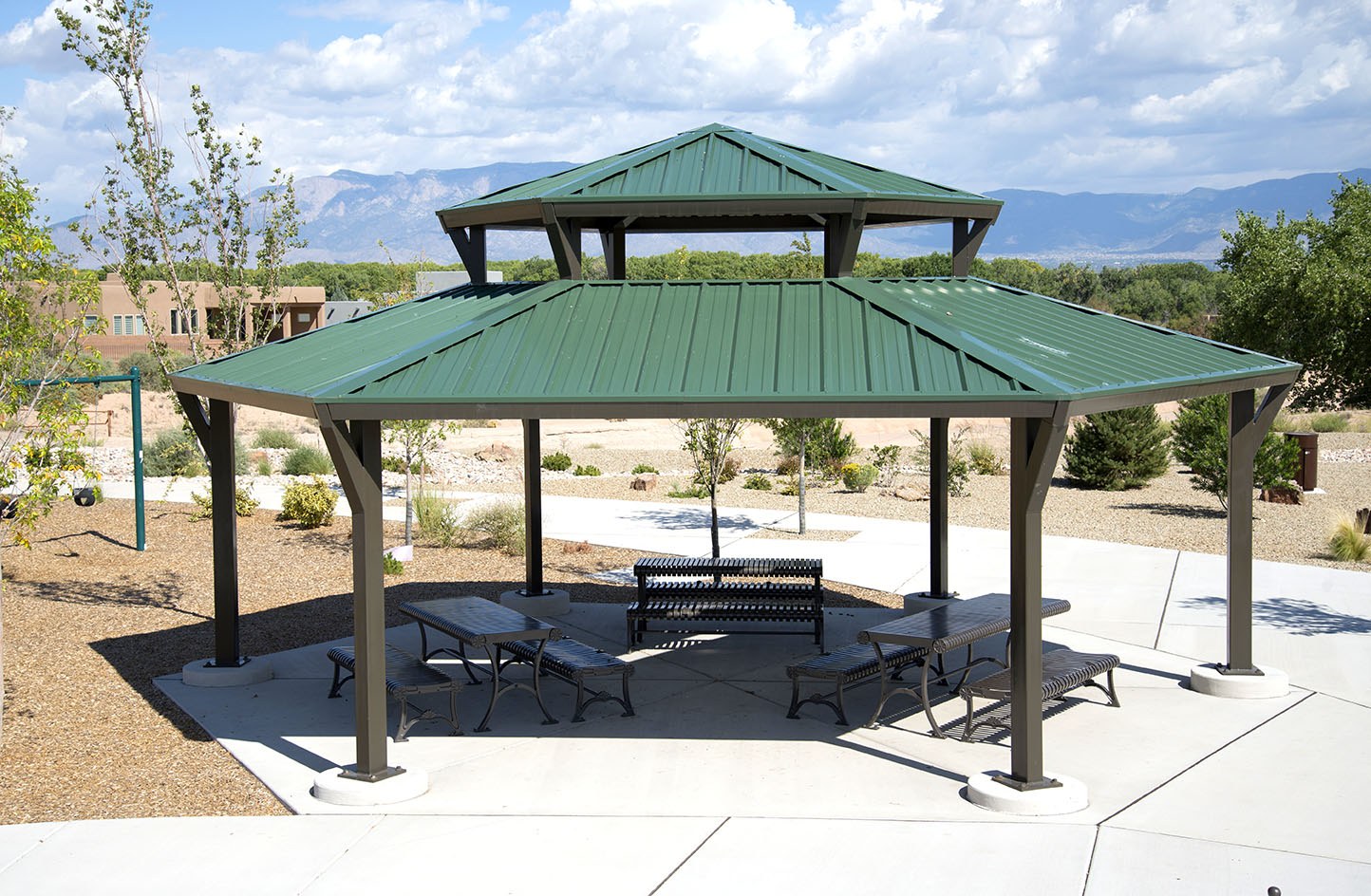
The roof sets the style. Underneath, every pavilion we supply is the same all-steel build from SRP Shelters, a powder-coated steel frame under a metal roof, made by Superior Recreational Products in Holland, Michigan. They don’t make aluminum or composite shelters, so if you wanted either, this isn’t the line.
The main roof shapes are square, hexagon and octagon, rectangles that end in a hip or a gable, and the monoslope that pitches one way. A cantilever has no front columns, which makes it one option for baseball dugout covers and walkways. Several styles can also add a two-tier “duo-top” roof or a cupola.
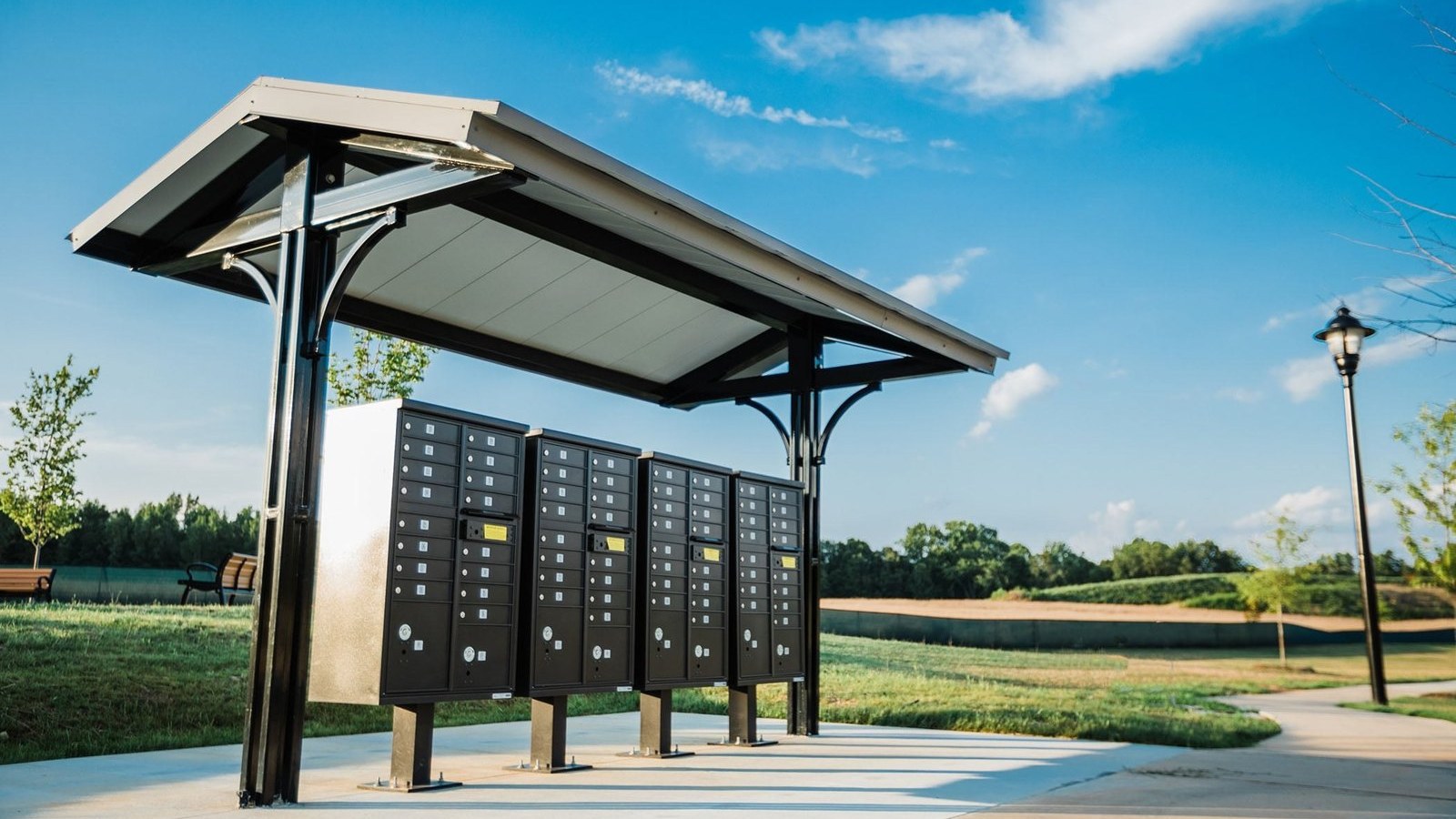
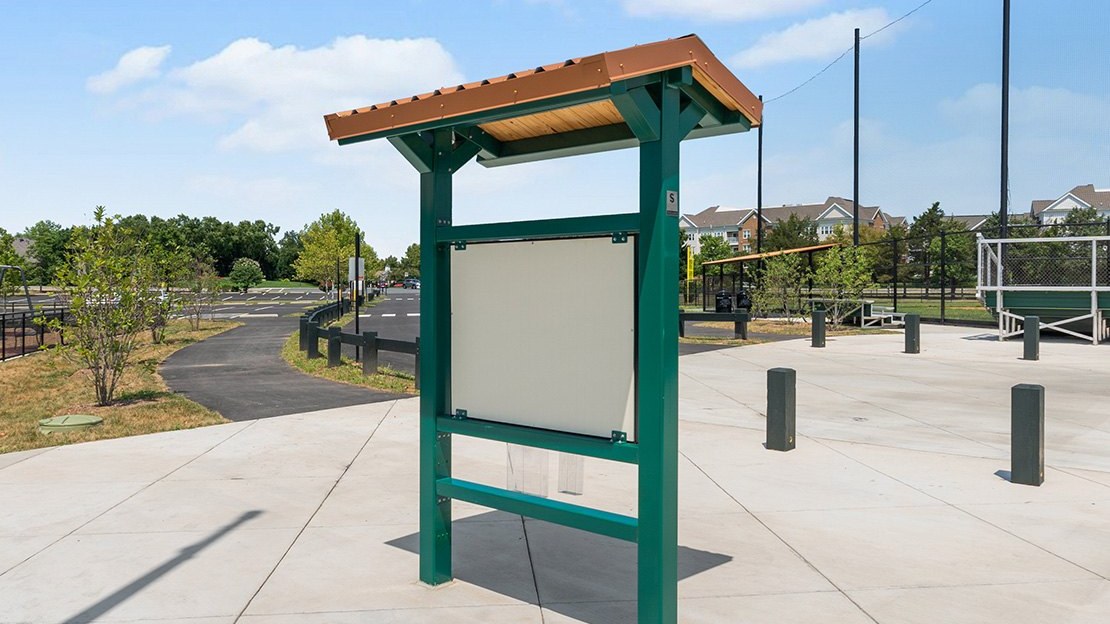
Smaller and special-use jobs have their own shelters. A two-post mini shelter covers a mailbox, a single table or a bus stop. Kiosks add a lockable display case, and a three-sided privacy enclosure screens up to two portable or accessible restrooms.
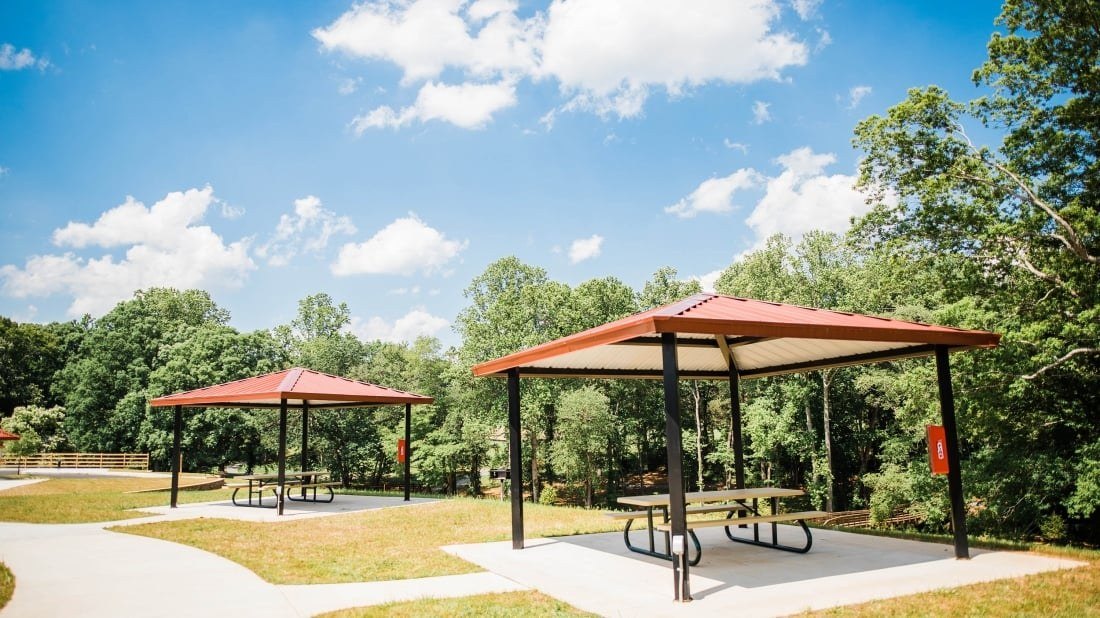
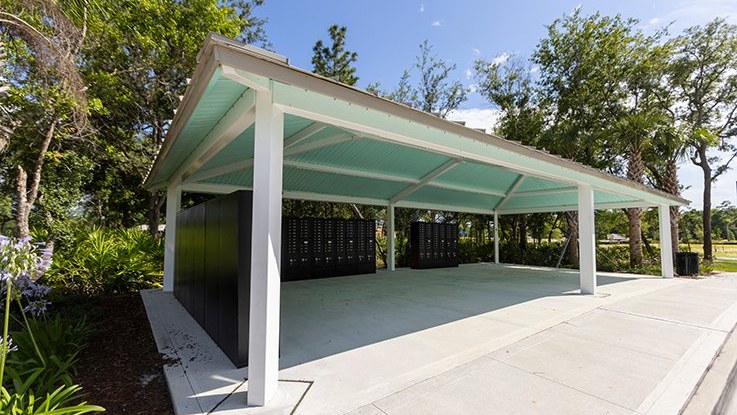
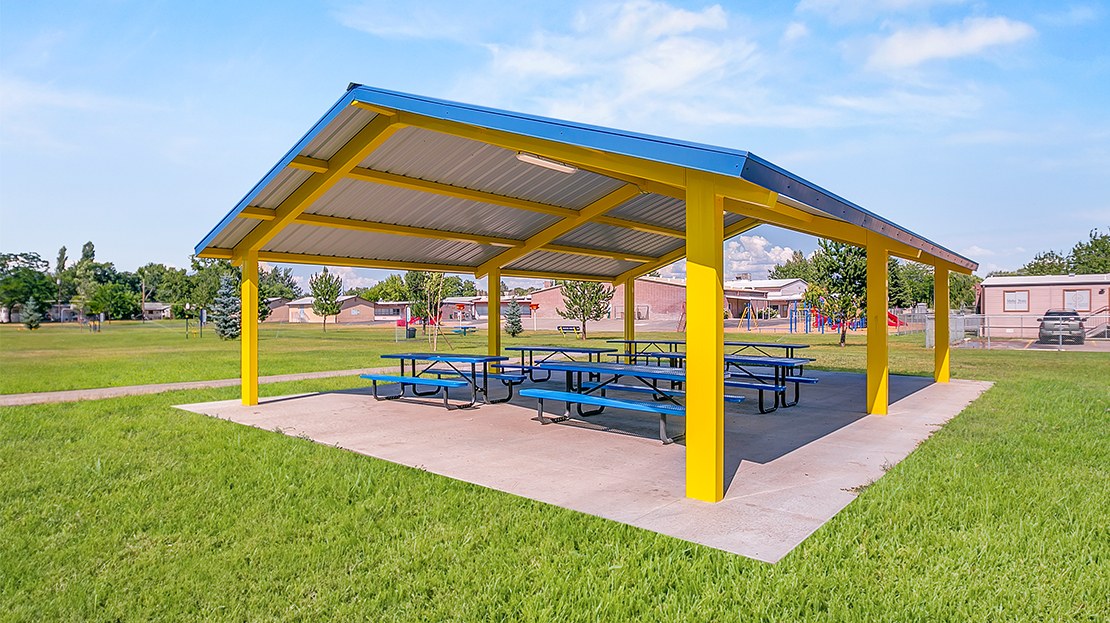
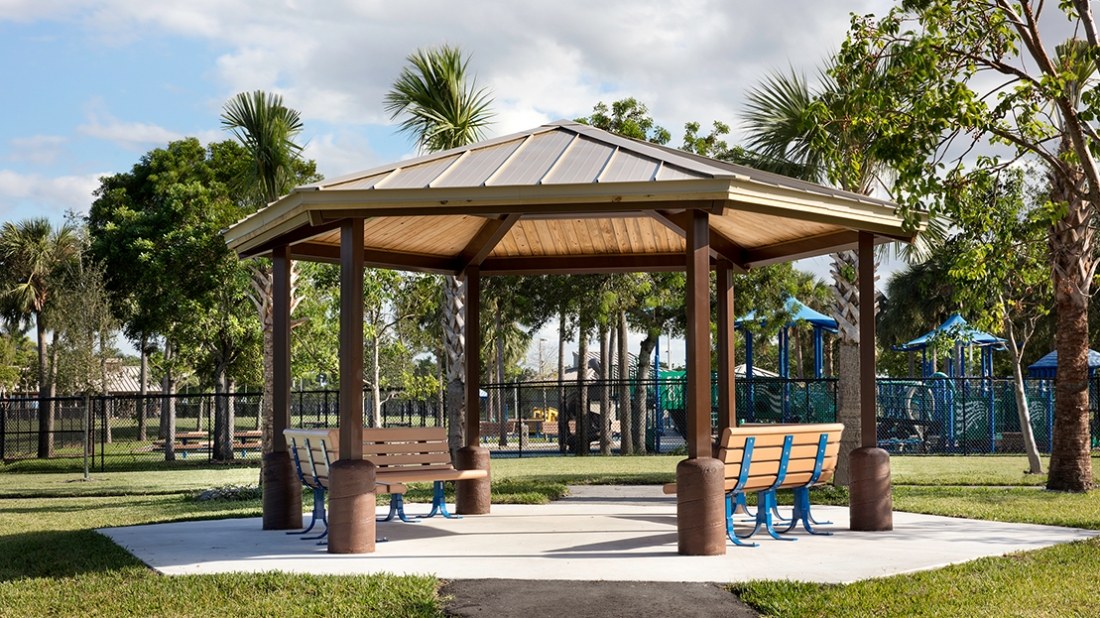
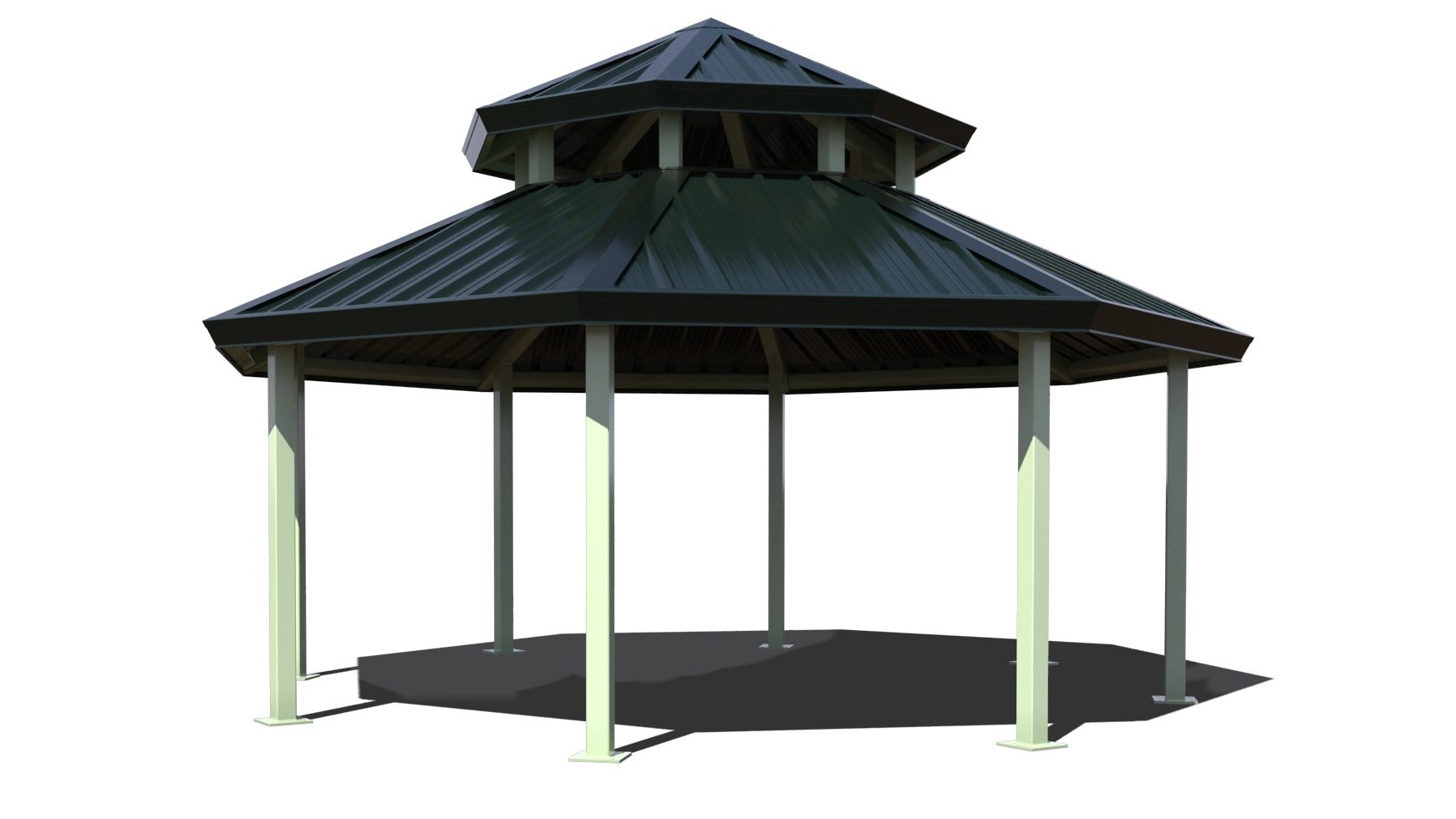
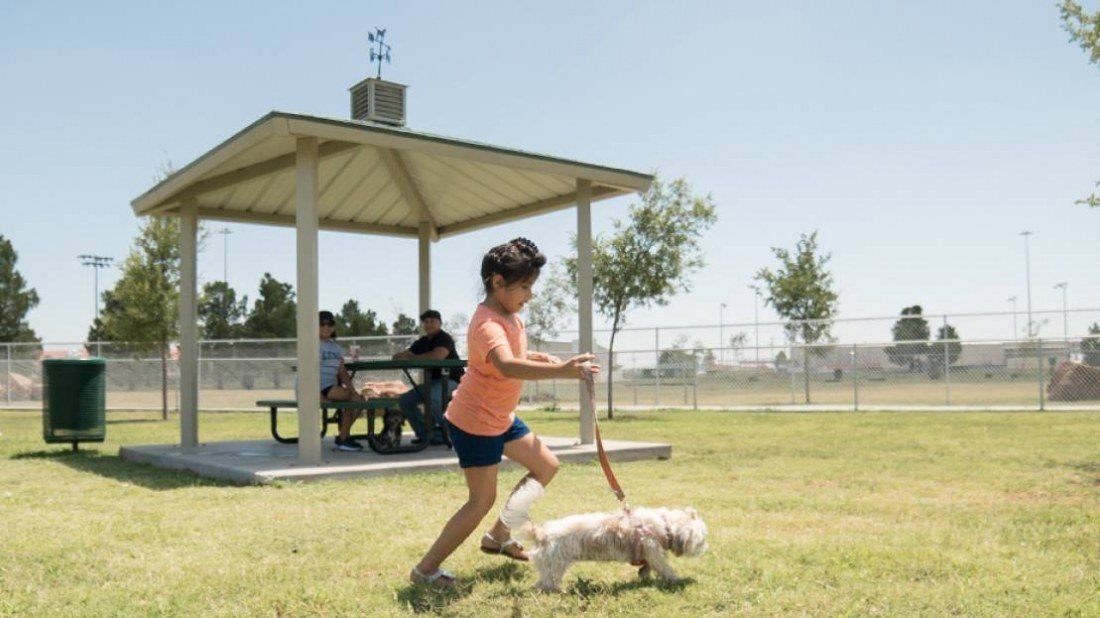
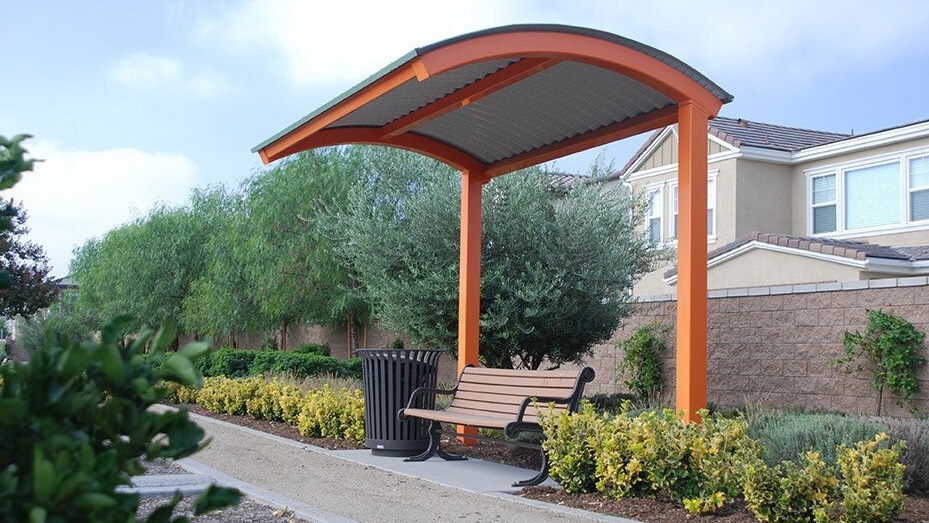
With the roof settled, color is the fun part: 24 metal roof colors and 28 powder-coat frame colors. Columns can be square or round, with ornamental lattice and guardrails as options, and base shoe covers hide the exterior anchor bolts at grade. If the shelter will have lights, the columns can come with electrical access cutouts built in.
How Big Should a Pavilion Be?
On a square or rectangular shelter, the manufacturer’s sizing works as a simple grid. Each rectangular picnic table gets about a 10-by-10-foot space (9’10” by 10’0″ exactly). A square table gets 10’5″ each way and a round one 11’0″ each way. You count how many fit along each side, round down, and multiply, so a 20×20 holds 4 rectangular tables, a 30×30 holds 9 and a 40×40 holds 16.
That round-down means the count only climbs about every 10 feet, so a 24×24 holds the same 4 tables as a 20×20. The extra roof buys shade, not another table.
For the outer limits, the manufacturer publishes sizes from 10′ to 50′ for square shelters, up to 64′ for hexagons and octagons, and up to 50′ wide and more than 100′ long for hip-end and gable-end rectangles. Height is simpler: on square and monoslope models, the standard entry height is 7’6″.
The grid leaves out any space for an accessible route, and New Jersey requires some of the tables to sit on one (see the accessibility section below). It also doesn’t apply to hexagons and octagons, so on those shapes we can work out the table layout with you on the drawings.
Steel Pavilion vs Wood Pavilion vs Fabric Shade
Steel and wood both need upkeep, just not the same kind of work.
| Material | Upkeep |
|---|---|
| Steel pavilion | Every year, someone touches up the powder-coat finish, exposed nuts and bolts too. Each touch-up gets documented in writing. Our supplier’s finish warranty requires both. |
| Wood pavilion | Treatment comes first. Many species decay when they’re kept damp outdoors, and preservative treatment adds a lot of life. Any wood touching the ground needs a ground-contact treatment (AWPA Use Category 4). After that comes refinishing: about every 1 to 3 years for a clear water-repellent finish, or 10 to 20 for paint, depending on climate, exposure and prep. |
Fabric shade is a different decision. It has to come down ahead of heavy wind and storms, and it isn’t built to carry snow. We sell Superior Shade fabric structures too, from the same company that builds the steel shelters we carry. For northern climates that see a lot of snow, though, that company recommends all-steel shelters, so a steel pavilion stays up year-round where a shade canopy gets taken down for winter.
Steel or wood, a permanent pavilion is a structure under New Jersey’s construction code, engineered for its site’s snow and wind loads.
How Much Does a Pavilion Cost?
By size, these are national 2026 budget figures, not quotes or a manufacturer’s price list.
| Shelter size | Shelter only (delivered) | Installed (footings or slab + erection) |
|---|---|---|
| Up to about 16×16 | $15,000–$25,000 | $30,000–$50,000 |
| 20×20 to 20×24 | $25,000–$35,000 | $45,000–$70,000 |
| 24×24 to 30×30, or 20×30 to 20×40 | $30,000–$45,000 | $60,000–$95,000 |
| 30×40 and larger | $55,000–$85,000+ | $100,000–$140,000+ |
Installed covers the shelter, footings or a slab, and erection. Sealed engineered drawings, permits, electrical work and a soil report come on top. Installed usually runs about double the shelter-only price. New Jersey jobs can run higher with rock or poor soil, heavier snow-load designs, and prevailing wage on public jobs, covered below. Hexagons and octagons are quote-only, since there isn’t enough data for a range.
The full project budget, line by line:
- The structure itself: size, style and add-ons
- Engineering and sealed drawings, plus a soil report if one is used
- Footings or a slab
- Freight, lifting equipment and installation labor
- Any electrical work, and permits
Shelters ship by freight truck, and the driver doesn’t unload. So every delivery needs a plan, and the equipment, to get the steel off the truck. A liftgate costs extra and has to be requested before shipment. When we handle the install, our quotes list shelter, freight and installation separately.
On public property, installation labor falls under New Jersey prevailing wage once the contract passes a threshold. That’s $19,375 for work a town awards and $2,000 for a school board or other public body. The rule follows the installation, so a supply-only contract falls outside it.
Ranges only go so far. For your own site, call 201-670-4000 or skip down to the quote form.
Do You Need a Permit for a Pavilion in NJ?
None of the code’s exceptions fits an anchored steel shelter. A temporary structure skips the permit only if it’s under 120 square feet and in place under 180 days. Tents and canopies lose their exemption once there’s a permanent anchoring system or foundation, which rules out a shelter on footings. As for sheds, the exemption covers only garden-type sheds of 200 square feet or less and 10 feet or less tall, and only beside residential buildings.
Lighting or outlets bring a separate electrical permit, and that holds even where a structure itself is exempt. On any edge case, the local construction official makes the call.
Snow, Wind and Footings: Engineering a Pavilion for New Jersey
A catalog load rating doesn’t tell you what a shelter has to carry. In New Jersey it gets engineered to snow and wind loads set by its address, and the sealed drawings state which code and loads it was designed to.
Designers get those loads from an address-level hazard lookup, and a city or zip code can underestimate them (DCA Bulletin 19-1). When the lookup can’t produce a number, DCA’s fallback ground snow values reach 50 psf in Sussex County.
For the permit, a permanent pavilion generally needs plans signed and sealed by an engineer or architect of record licensed in New Jersey (N.J.A.C. 5:23-2.15(f)1, DCA Bulletin 96-2). A construction official can waive plans for minor work. The manufacturer prices its sealed engineered drawings separately. I’d confirm whether those carry a New Jersey seal or need a New Jersey engineer’s review.
The drawings also name a code edition, and New Jersey’s building subcode has been the 2024 International Building Code since August 17, 2026. That edition matters, because the manufacturer’s shelter warranty limits its code liability to the building code printed on the drawings.
The last piece is the ground. Footings go below frost depth, which runs deeper up north, and their size comes down to what the soil can bear. Without a soil report, the manufacturer’s engineers have to assume a conservative low value, which usually makes the footings bigger than the soil needs. A report pays off most on shelters 35 feet or larger, shelters with six or more columns, or hard or rocky ground, according to the same company’s guidance.
Do Picnic Shelters Need ADA Picnic Tables in NJ?
New Jersey’s picnic-area rule is about the route and the share of tables on it, not a table design. At least 5% of the picnic tables provided, rounded up and never fewer than one, have to sit on an accessible route. That rule covers benches, fireplaces and grills too, and those on the route must be spread through the picnic area as far as the terrain allows. The duty sits with the facility’s owner and manager, public or private.
A new shelter also needs an accessible route to it. New Jersey’s Barrier Free Subcode counts a recreation-area shelter as a “support facility,” and every support facility needs an accessible route from at least one site access point (N.J.A.C. 5:23-7.17 and 5:23-7.19). Besides standard accessible-route surfaces, the subcode accepts flat pavers on concrete or sand, wood decking, and crushed stone bound with enough cement to stay firm.
The federal picnic-table specs call for one 30″ x 48″ wheelchair space per 24 linear feet of usable table edge, with 36″ of clear ground on each usable side. Per the Access Board, they have no legal effect on state and local governments or private owners. I still think they’re a good design target.
How NJ Towns and Schools Buy a Pavilion
New Jersey public purchasing runs on dollar thresholds. Here they are for a town or school board that has a Qualified Purchasing Agent.
| Contract amount | What the law asks for |
|---|---|
| Under $7,950 | No quotes required |
| Between $7,950 and $53,000 | At least two quotes |
| Above $53,000 | A public bid, or a state contract or registered co-op |
A Qualified Purchasing Agent only changes a unit’s own thresholds. Without one, the limits drop: school boards bid above $39,000, and towns and counties above $17,500.
We’re an approved vendor in the Bergen County Cooperative Purchasing Program, and that contract covers installation. Any New Jersey public entity joins by resolution, with or without a Qualified Purchasing Agent. Membership carries no fee, and the entity’s purchasing office can issue a purchase order against the contract with no separate RFP. For funding, start with our New Jersey park grants page.
None of that table applies to private buyers. HOAs, churches, private schools and private daycares aren’t bound by the public bidding law, so their own approval process makes the call.
For any buyer, a shelter is made to order and can’t be returned once it’s released. That makes the drawing review before release the real decision point.
Pavilion Installation in NJ: Who Does the Work?
Check the shipment before anyone signs for it. I’d count and inspect every piece and write any damage on the receipt. If you leave the driver instructions instead of signing in person, that counts as a signature with no damage noted. The manufacturer doesn’t guarantee replacement parts for damage that wasn’t reported.
Touch-up paint ships with the shelter, and the protective wrapping should come off within seven days so it doesn’t damage the powder coat.
The shelter comes as factory-welded parts that bolt together, with no field welding, and all the assembly hardware is included. On site, the build runs in a set order:
- Locate utilities.
- Pour footings or a pad to the drawings, with the anchor bolts placed accurately.
- Lift the steel into place with a small crane or other safe means, and bolt it together.
Anchoring hardware beyond the standard bolts is the installer’s responsibility.
Pavilion Upkeep
The manufacturer backs each shelter with a 10-year shelter warranty, pro-rated and limited, that runs from the shipping date, not the install date, plus a finish warranty on the powder coat.
Every year, that finish warranty requires two things from you: touch up the finish, including the exposed nuts and bolts, and keep a written record of the work.
Our supplier’s finish warranty also excludes sites where salt air, a corrosive environment, high humidity or sprinkler systems come in contact with the shelter. For a coastal, lakeside or sprinkler-wet site, ask us about those terms before you choose a shelter.
Pavilion FAQ
Is a gazebo considered a pavilion?
In everyday use, more or less, since the words overlap. Our supplier builds gazebos in round, square, rectangular, hexagonal and custom shapes, so the word doesn’t settle the shape. Its gazebos have no floor of their own and sit on concrete footings or a full pad.
How much would a 20×20 pavilion cost?
As a budget range, a commercial steel shelter that size runs roughly $25,000–$35,000, or $45,000–$70,000 installed (full table). Add drawings, permits, any electrical work and the soil report to that. The site moves the final number, which comes by quote.
What is the standard height for a pavilion?
The square and monoslope models we supply have a 7’6″ standard entry height.
How do I build a picnic shelter?
First, get a permit through the local construction official, since building a structure without one is unlawful in New Jersey. After that, the steel shelters we supply go up in a fixed order: a utility locate, footings or a pad poured to the drawings, then the factory-welded parts lifted into place and bolted together.
Do I need a permit for a gazebo in NJ?
A permanent gazebo at a park, school or church needs one, yes. New Jersey’s code requires a permit from the local construction official before any building or structure goes up. The tent and canopy exception ends with any permanent anchor or foundation, footings or a concrete pad alike. Sheds are exempt only when they’re small garden-type sheds beside residential buildings. Small backyard structures are that official’s call.
How much does it cost to install a pavilion?
Installation, meaning footings or a slab plus erection, usually runs about the shelter price again, so installed comes to roughly double the shelter. Sealed drawings, permits, electrical and a soil report are on top. In New Jersey, rock or poor soil, a heavier snow-load design, or prevailing wage on a public project can push it higher. Who installs depends on the job.
Is a commercial steel shelter a kit?
Not a homeowner kit. Our supplier’s shelter warranty assumes whoever assembles it has the trades’ expertise and tools.
Quotes and Site Visits
Getting a quote
We offer a site visit for pavilion projects, same as we do for commercial playgrounds. For a quote, or a question this page didn’t answer, use the form below or call 201-670-4000.
Or send the details here