
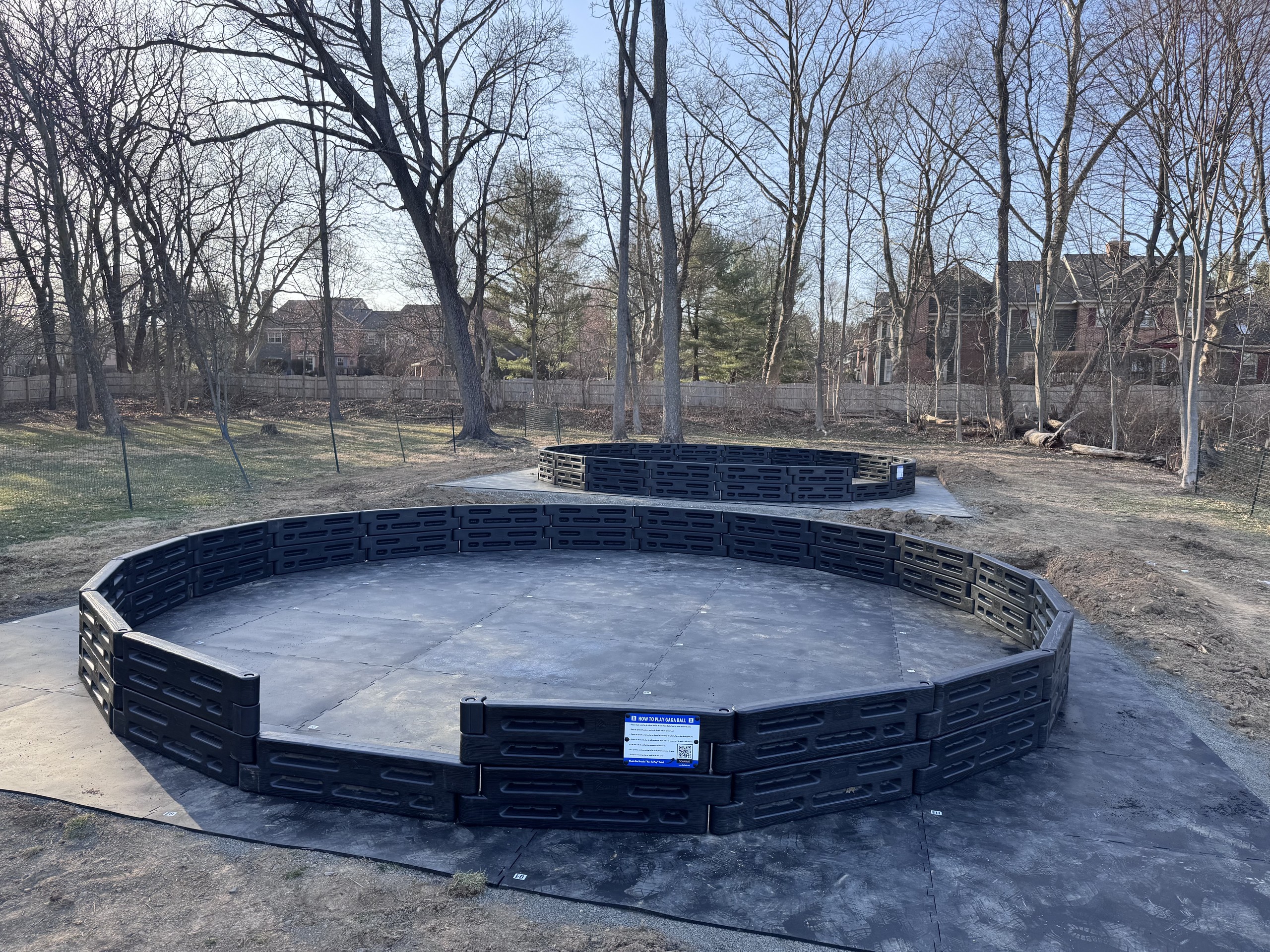
Commercial Gaga Ball Pits for New Jersey Schools, Camps and Parks
- What Is a Gaga Ball Pit?
- Gaga Ball Pit Dimensions: What Size Do You Need?
- What Is a Commercial Gaga Pit Made Of? Plastic, Steel or Wood
- What Is the Best Surface for a Gaga Pit?
- In-Ground, Portable or Indoor: How a Gaga Pit Is Installed
- How Much Does a Gaga Ball Pit Cost?
- Gaga Ball Pit FAQ
- Gaga Pit Quotes

What Is a Gaga Ball Pit?
Gaga is dodgeball with an open hand, played inside the pit’s wall. The ball has to bounce three times before it’s live, and after that, nobody can touch it twice in a row. In most rule sets a hit at or below the knee puts you out, and the last kiddo standing wins.
Two more rules depend on the wall: knock the ball over it and you’re out, and you can’t sit on top of it.
Gaga Ball Pit Dimensions: What Size Do You Need?
Swings, slides and other playground equipment need a clear area around them, and I’d keep the pit out of that space. Leave open ground outside the pit too, because kids go over the wall during play.
| Pit size | Players |
|---|---|
| 15′ | About 8 to 15 |
| 20′ | About 12 to 25 |
| 26′ | About 20 to 30 or more |
What Is a Commercial Gaga Pit Made Of? Plastic, Steel or Wood
Commercial gaga pits are built three main ways: plastic timbers on steel spikes, steel frames with plastic panels, or pressure-treated wood. Wood pits need wood filler and fresh stain over the years. Our standard pit uses plastic timbers 12 inches tall, stacked two high and held in place by steel spikes, for a wall about 24 inches tall.
We also carry a high-wall pit in the same three sizes. It’s an in-ground model built three timbers high (12, 8 and 12 inches), about 32 inches in all. Older or bigger kids send fewer balls over its taller wall, so the ball stays in play and games move faster. Both pits have an entry cutout where the top row is left open, so kiddos step over a lower section of wall to get in and out.

What Is the Best Surface for a Gaga Pit?
The floor is a trade-off: a hard, smooth floor gives the best bounce and footing, while a cushioned floor protects kids who fall or go over the wall.
Our gaga pit flooring is 5/8″ rubber in 48″ x 72″ tiles that lock together, custom-cut for the 15′, 20′ or 26′ pit. It keeps mud, dirt, grass, sticks and rocks out of the pit, and it drains well.
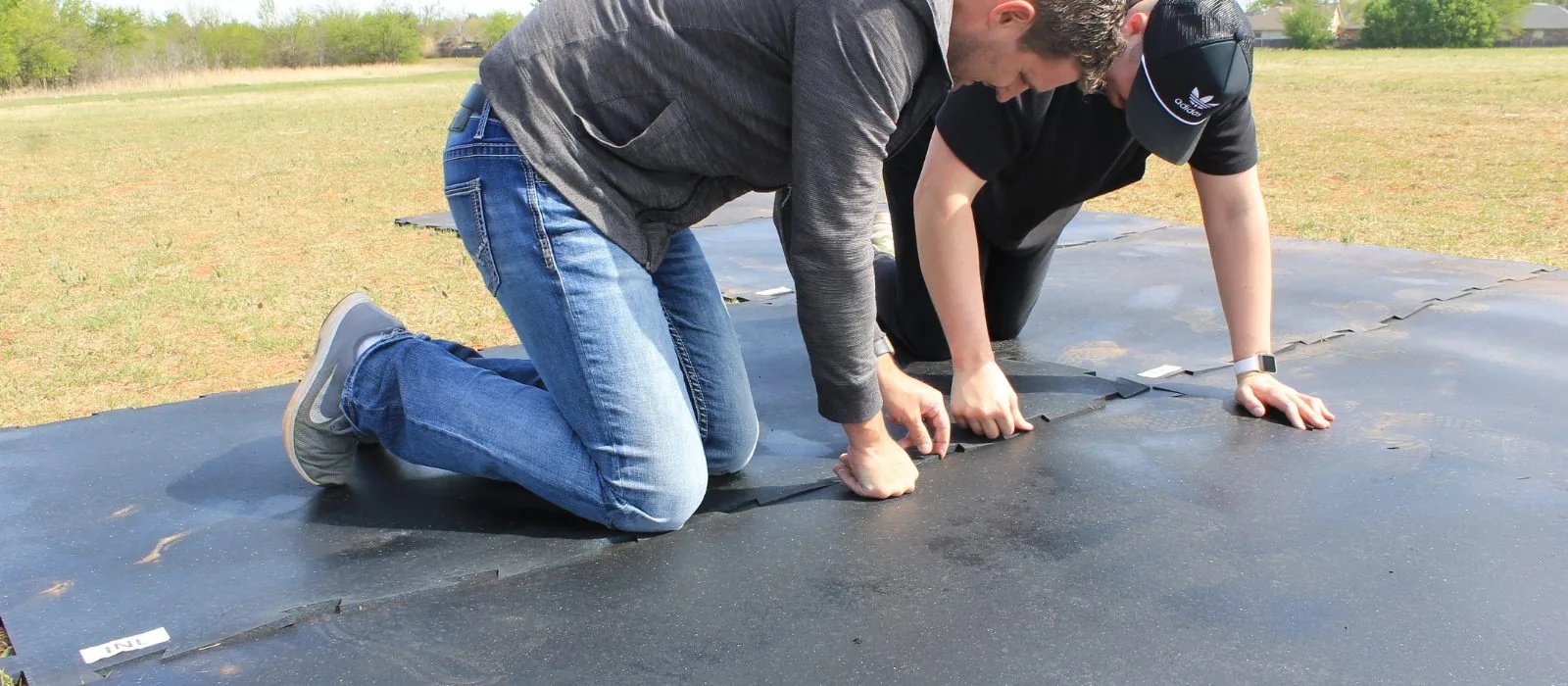
That same flooring is inside the two 26′ gaga pits we installed at River Crossing YMCA in Doylestown, PA. The mats are softer underfoot than asphalt or packed dirt, but they aren’t the cushioned fall-protection surfacing that goes under swings and climbers.
People who pick turf want a pit that looks and feels like grass, and they accept a bigger install to get it. The install is hardest over grass, where the dirt gets dug out, a crushed stone base goes down and gets compacted, the area is framed, and then the turf goes on top.
| Surface | What happens |
|---|---|
| Grass | Heavy play wears it down to dirt and mud. |
| Asphalt or concrete | Some insurance companies warn in their guidance that hard surfaces can lead to injuries. |
| Sand or pea gravel | Both drain well, but kids throw them. The NJ MEL Safety Institute, an insurance pool that serves many NJ towns, warns in its gaga ball bulletin that loose sand can be an eye hazard. |
In-Ground, Portable or Indoor: How a Gaga Pit Is Installed


The high-wall pit we installed at The Village School in Waldwick is an in-ground one, a gift from that year’s graduating class!
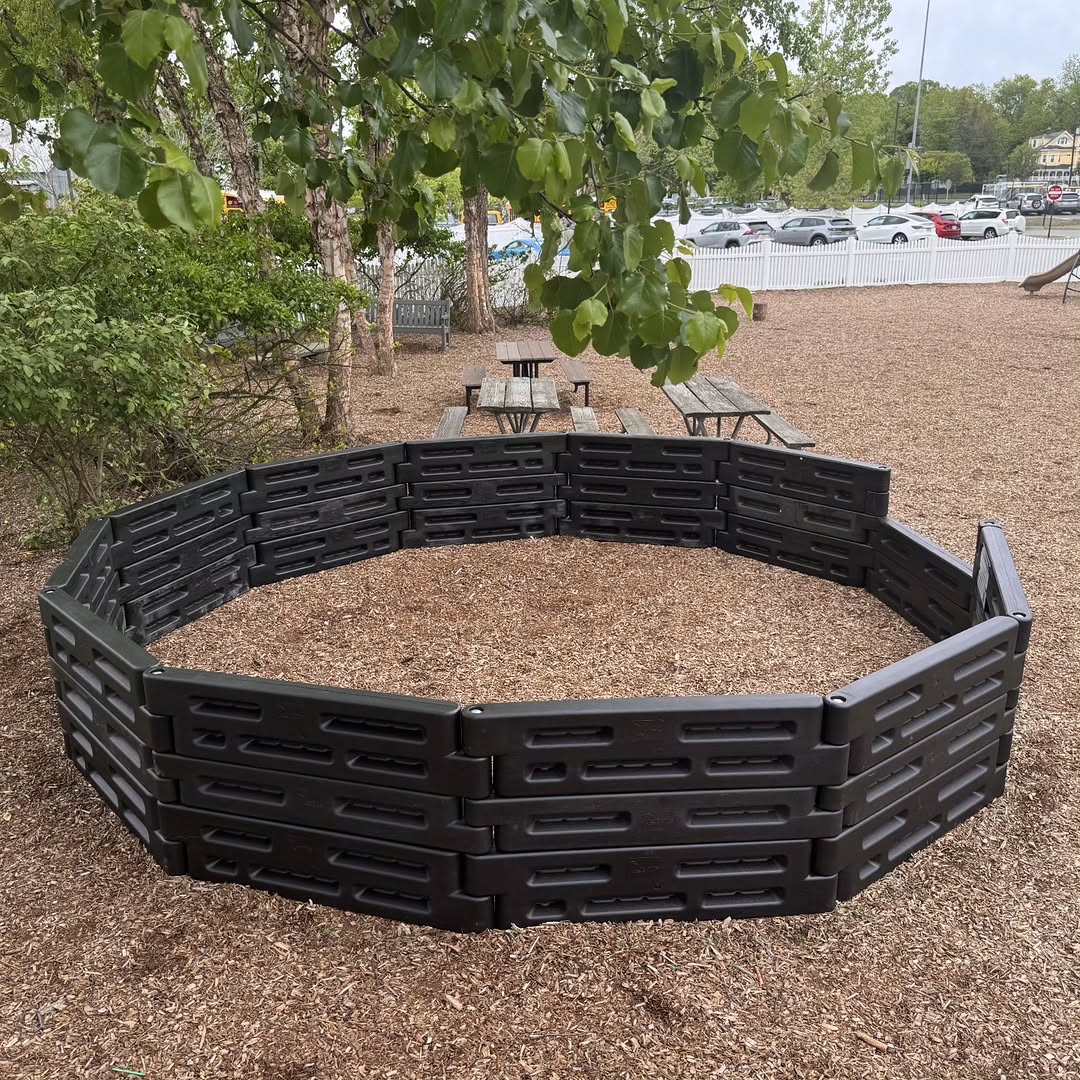
Outdoors, most pits go in the ground. When a pit has to sit on asphalt, we use the portable version. Our rubber mats usually go inside it.
On a public site, such as a school or park, the ADA calls for an accessible route to the pit. New Jersey’s playground code also bars sand and gravel from routes and spaces that have to be accessible, when new equipment goes in on a playground where the state’s barrier-free rules apply.
Any pit set on uneven ground can go together egg-shaped, so level ground matters. Check the spikes and timbers before play, because a loose timber becomes a trip hazard.
How Much Does a Gaga Ball Pit Cost?
Current prices for the standard pit, in every size and both versions, are posted on our gaga ball pit listing. The high-wall pit has a separate page, and you’ll find the mats under flooring.
At every size, the high-wall pit costs more than the standard in-ground pit, and the portable costs more than the in-ground one. On top of the pit itself, flooring inside it, site prep, freight and installation labor all add to the price, and we quote freight and installation separately.
For a number on your own site, call 201-670-4000 or jump down to the quote form.
Gaga Ball Pit FAQ
Can you play gaga ball without a pit?
Yes, kids can play on open ground. Two rules need a wall, though, like the out for knocking the ball over it.
Can you play gaga ball on grass?
Yes, though grass inside a busy pit won’t last. It turns to dirt, then mud.
How many people can play in a GaGa pit?
Seller listings vary, but they typically give a 15′ pit about 8 to 15 players, a 20′ about 12 to 25 and a 26′ about 20 to 30-plus.
What size ball to use for GaGa Ball?
Sellers list 8.5-inch rubber playground balls for gaga. No governing body sets a spec for the ball, though, and the MEL bulletin calls for a foam one.
What age is gaga ball for?
We list our standard pit for kids 5 to 12. With mixed ages, the MEL bulletin’s rule of thumb is to group kids so each group spans about two years.
How tall should a gaga ball pit be?
Our standard pit’s wall is two timbers high, about 24 inches, and the high-wall pit adds a third row for about 32 inches.
Can a gaga ball pit go indoors?
Our portable one can. Its spikes sit in rubber bases rather than the soil, so it works on gym floors. The in-ground version can’t, because it anchors into the dirt.
Do you install gaga ball pits in New Jersey?
Yes. We’re based in Midland Park, NJ, and install in New Jersey and in parts of New York, Connecticut and Pennsylvania. If your own crew would rather put it in, we’ll ship the pit to you anywhere in the country.
Gaga Pit Quotes
Getting a quote
Tell me the size you have in mind and where the pit would go, using the form below, or call me at 201-670-4000.
Or send the details here